


Catholic eisegesis on Acts 8:30-31 refuted

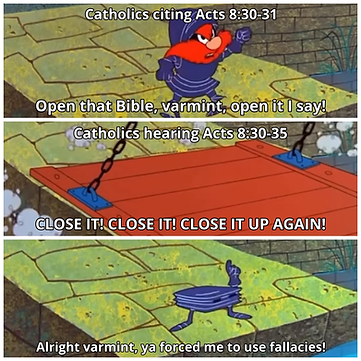
“So Philip ran to him, and heard him reading the prophet Isaiah, and said, “Do you understand what you are reading?” And he said, “How can I, unless someone guides me?” And he asked Philip to come up and sit with him.” - Acts 8:30-31
If you ask a Roman Catholic (or, more likely, if they mention it to you), Acts 8:30-31 proves that Scripture cannot be interpreted on its own. It requires an authoritative interpreter to explain it. But as with all prooftexts, reading the context tells us a different story. The passage continues:
“The place in the Scripture which he read was this: “He was led as a sheep to the slaughter; And as a lamb before its shearer is silent, So He opened not His mouth. In His humiliation His justice was taken away, And who will declare His generation? For His life is taken from the earth.” So the eunuch answered Philip and said, “I ask you, of whom does the prophet say this, of himself or of some other man?” Then Philip opened his mouth, and beginning at this Scripture, preached Jesus to him.” (Acts 8:32-35).
Here, we see exactly why the Eunuch needed help. We now know what the eunuch actually asked. If we know what the eunuch asked, we know what he didn’t understand. Knowing what he didn’t understand, we even see why he didn’t understand it. It wasn't that he had no authoritative interpreter. In fact, why would he even assume Philip - this random Jew - had any more authority than anyone else? What we see here is an entirely normal situation that occurs just as regularly in our day. When you want to understand a religious text, ask someone who follows that religion. The eunuch wasn't asking for an authoritative interpreter. He was asking for context. Context provided in the New Testament that, at this point, did not exist. Now that it does exist, we don’t need Philip to explain Isaiah 53.
This is a fact for which we can all be grateful. Philip, ladies and gentlemen, is dead. All of the Apostles are dead. All the people who knew the Apostles are dead. All the people who knew the people who knew the Apostles are dead. We are living at the current end of a long chain of death. A long chain of death spanning approximately 2,000 years.
The thing about oral tradition is it dies in the ear. It may be remembered, especially when actively attempted, but anyone who’s ever played Chinese Whispers knows that oral tradition sucks as a method of preservation. But writing doesn’t perish as easily. It doesn’t rely on fragile memories, it can be copied, and once copied, it can be verified. So, when Paul wrote “Therefore, brethren, stand fast and hold the traditions which you were taught, whether by word or our epistle” (2 Thessalonians 2:15), he wasn’t saying “we’re giving you half by one method, and half by the other”. Rather, they delivered the same traditions by both methods. We see an example of this in Acts 15:27, following the Council of Jerusalem (which, ironically, is another commonly misquoted passage to defend Catholic authority). Here, we read "We have therefore sent Judas and Silas, who will also report the same things by word of mouth." Notice, the same things. The Apostles taught their traditions by both written and oral tradition, their inevitable demise has rendered only one of those methods applicable today.
And you better heed it.
See, there is a grand irony here. While they’re emphasising the word “tradition”, and specifically focusing on “by word”, they end up overlooking “by our epistle”. The Scriptures, my friends, are the traditions we are being admonished to keep. The Apostles weren’t secretly running around preaching things they forgot to write down. Everything the Apostles wanted us to believe is in the palm of your hand every time you open the Bible. You don’t need their mythical successors to interpret them for you, the Scriptures are the interpretation. They are a light in a dark place. You don’t need a light to be illuminated, you use the light to illuminate. So what kind of nonsense is this “authority to interpret”? If you can interpret the opinions of the Catholic Church, you can interpret the opinions of the Apostles. But only one of those traditions was breathed out by God (2 Timothy 3:16-17).
In fact, not only breathed out by God, but even written down by the very Apostles themselves. That is, the very people the Catholic Church claims are the authoritative interpreters. So, let's take a look at what Peter - supposedly their first Pope - said about Scripture:
“For we did not follow cunningly devised fables when we made known to you the power and coming of our Lord Jesus Christ, but were eyewitnesses of His majesty. For He received from God the Father honor and glory when such a voice came to Him from the Excellent Glory: “This is My beloved Son, in whom I am well pleased.” And we heard this voice which came from heaven when we were with Him on the holy mountain. And so we have the prophetic word confirmed, which you do well to heed as a light that shines in a dark place, until the day dawns and the morning star rises in your hearts; knowing this first, that no prophecy of Scripture is of any private interpretation, for prophecy never came by the will of man, but holy men of God spoke as they were moved by the Holy Spirit.” (2 Peter 1:16-21).
Now tell me, what do lights do in a dark place? Do we need help to see it, or do we use it to help us see everything else? It doesn't take a genius to recognise that what Peter is telling us the Scriptures are nothing to sneeze at. They are reliable, because its authors were guided by the Holy Spirit Himself. The Apostles were witnesses to the fulfillment. Why did Philip know Isaiah 53 was about Jesus? Because he had access to what the eunuch did not. In fact, what's interesting is that it seems the prophets themselves did not understand, for Peter had previously written:
"Of this salvation the prophets have inquired and searched carefully, who prophesied of the grace that would come to you, searching what, or what manner of time, the Spirit of Christ who was in them was indicating when He testified beforehand the sufferings of Christ and the glories that would follow. To them it was revealed that, not to themselves, but to us they were ministering the things which now have been reported to you through those who have preached the gospel to you by the Holy Spirit sent from heaven—things which angels desire to look into." (1 Peter 1:10-12).
How was the Eunuch supposed to understand what Isaiah was speaking about if Isaiah didn't know exactly who he was speaking about? But we do! We have the Apostolic tradition in full in the New Testament. So in what universe does a pre-New Testament Gentile not understanding the Old Testament prove we need an authoritative interpreter of the Bible as a whole? The irony is, there is no "authoritative interpretation" of Acts 8:30-31 along these lines! That means Catholics are privately interpreting the Bible to say you can't privately interpret the Bible! The very existence of this argument disproves the argument! In other words, these Catholics are saying they can't understand the Bible unless someone explains it to them. So you can now explain it to them.
AI usage
This article contains no AI generated content.


Comments