


Jerome, Asceticism, and the Authority of Scripture


One thing I’ve often said is that “extremism breeds extremism”. When you respond to an extreme view, you can often appear to be supporting the other extreme. Worse than this, on occasion, this can become more than just an appearance.
On this ministry, I deal with a number of different worldviews, but the second most common is Roman Catholicism. Roman Catholicism places a very heavy emphasis on Church history, to the extent where any discussion will inevitably lead to certain claims being made about history, while the Bible just gets shelved. This is such an extreme approach that any response may seem equally extreme. When we treat history as less valuable than Scripture, we can appear to be treating history as though it is entirely devoid of value.
For this article, I have chosen Jerome as my example. Jerome is considered a Church “Father”, and as such, his opinions are highly respected in almost every circle. The vast majority of Christians will admit he has some fairly useful insights. Claims he was a die hard heretic who never spoke a word of truth tend to be limited to meme-level dunces.
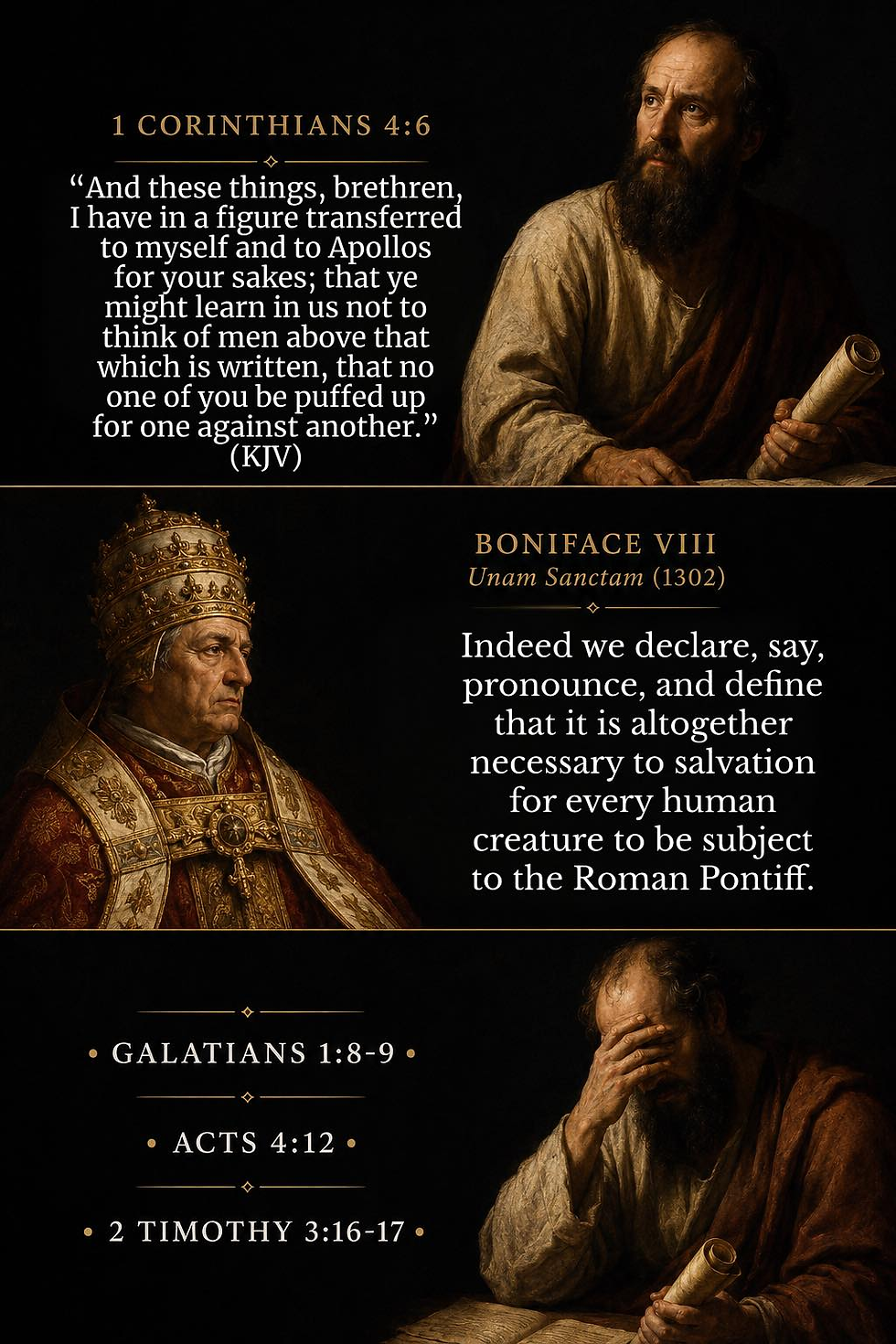
In the first panel of the header image, I’ve selected a quote I very obviously agree with. Jerome did not treat Scripture as some unintelligible book that requires an infallible interpreter, he encouraged people to study it diligently. Thus, he wrote "Read the divine scriptures constantly; never, indeed, let the sacred volume be out of your hand." (1). This, like many of Jerome's writings, is very solid advice, and it gives us great insight into the religious culture of his day.
However, like all men, some of his views were quite inappropriate. Some of his errors are not even commonly held today. For example, in Against Jovinianus, Book 1, Jerome wrote several things that treat Scripture as an absolute joke by denigrating sex and marriage. In it, he first states "...as regards Adam and Eve we must maintain that before the fall they were virgins in Paradise: but after they sinned, and were cast out of Paradise, they were immediately married." (2). Already, anyone who has read Genesis can see the issue here. The marriage of Adam and Eve occurs in both Genesis 1:26-31 (declaring it "very good", contrary to Jerome's continued ramblings), and Genesis 2:18-25. Neither of these events happened after the Fall, which occurs a chapter later. While theoretically possible that Adam and Eve never consummated their marriage before the Fall, to deny their marriage prior to the Fall requires a level of ignorance for which Jerome had no excuse.
However, the excuse Jerome would likely have had is that he had a particular opinion on sex within marriage. "Does he imagine that we approve of any sexual intercourse except for the procreation of children?" To this, my question would simply be "why not"? If Jerome had taken his own advice and never let the Sacred Volume out of his hands, he would see that such a teaching is entirely alien to it. Paul dedicates an entire chapter to principles of marriage, in which he says, among other things:
"Now concerning the things of which you wrote to me: It is good for a man not to touch a woman. Nevertheless, because of sexual immorality, let each man have his own wife, and let each woman have her own husband. Let the husband render to his wife the affection due her, and likewise also the wife to her husband. The wife does not have authority over her own body, but the husband does. And likewise the husband does not have authority over his own body, but the wife does. Do not deprive one another except with consent for a time, that you may give yourselves to fasting and prayer; and come together again so that Satan does not tempt you because of your lack of self-control." (1 Corinthians 7:1-5).
I'm sorry, what's that? "He who too ardently loves his own wife is an adulterer"? No, nothing of the sort! Notice, childbearing isn't even hinted at in this passage. It's all about the affection spouses owe each other. It discourages extended periods without this affection, rather than setting arbitrary limits upon the affection rendered. The Bible is quite clear that, whereas sex outside of marriage falls under fornication or adultery, sex within marriage is pure and undefiled.
So, while Jerome and his ilk treated sex as nothing more than a baby making mechanic that should be avoided in all other circumstances, Scripture is very clear: What a man and his wife do in the privacy of their marriage bed is their own darn business. Radical ascetics have the right to choose celibacy for themselves, and indeed, such is actually spoken of very highly. However, they have absolutely no business invading the sanctity of another couple's marriage.
As far as I’m aware, pretty much everyone understands this these days. There might be a few exceptions, the majority of whom will call themselves “1st Baptist Church…”. But generally speaking, our culture seems to have largely forgotten Asceticism. We look back on them as excessive, and frankly rather goofy. But it really was the “in” thing at the time. It came in early, it spread far, and it was very difficult to displace.
Now, I could have chosen just about any example I wanted here. Jerome’s “ardent lover” blunder is what's referred to as "low hanging fruit", because it's widely circulated on the internet, and almost everyone I encounter will be able to spot the flaw instantly. Even the few holdouts can be silenced with a single boop from Hebrews 13:4. But history is flooded with examples of Biblical blunders that are either not believed by anyone, or are at least no longer within the realms of official Catholic doctrine.
And of course, the latter is the point I’m really trying to make. It’s not that history is useless, it’s that history isn’t as supportive of Catholicism as Catholics want to claim. More importantly, it’s all subject to Scripture. Jerome does not define Scripture. Irenaeus does not define Scripture. Ignatius does not define Scripture. In fact, I’m going to say something that I can guarantee you will sound extreme: The Biblical authors do not define Scripture.
Now, that’s going to need some fleshing out, because while I deny the authority of the so-called Church “Fathers”, I’m obviously not going to deny the authority of the hand-chosen stewards of the mysteries of God. But what I am going to say is that the message had greater authority even than the messenger. We look at Galatians 1:8-9 as an example. Here, Paul says twice that if anyone preaches another gospel, “let him be anathema”. He even includes the Apostles as a category. “But even if we, or an angel from heaven, preach any other gospel to you than what we have preached to you, let him be accursed. As we have said before, so now I say again, if anyone preaches any other gospel to you than what you have received, let him be accursed.” (Emphasis added).
Of course, that would be a pretty massive “if”. I don’t think there was ever a time when Paul would have preached any other gospel. Peter needed a bit of a heavy handed rebuke to get his behavior back in line with it (Galatians 2:11-14), but I don’t think even he would’ve brought that curse upon himself by actually preaching a different gospel.
But notice the severity of it Peter's behavior. "And the rest of the Jews also played the hypocrite with him, so that even Barnabas was carried away with their hypocrisy." (Galatians 2:13). Whose hypocrisy? Peter's hypocrisy. Not a Church “Father”. Not a random deacon. Not some new convert in the pews. Peter, a legitimate Apostle, one who even in the same epistle was listed among those who “seemed to be pillars” (Galatians 2:9), nevertheless lead Barnabas (and others) astray.
So, what should Barnabas have done in this scenario? The rebuke Paul gave should have come from Barnabas. And if not from him, anyone had the authority. Scripture doesn’t call on us to blindly follow our leaders. Even the legitimate ones must be held accountable. Where does that accountability come from? It can’t always come from another Apostle, especially since there are no more Apostles to correct anyone.
But Scripture is. And it’s not going anywhere. If the Lord tarries, the Bible will outlive all of us. It will continue to be true, even over genuine leaders, be they living or dead. So we always test them against it. If they preach the truth, all glory to Christ. But when a man makes a claim that is opposed to Scripture, there is no amount of authority that can rescue that claim. It is false. Thus, all of history must be put in its proper place. That place is beneath Scripture, which is breathed out by God Himself (2 Timothy 3:16-17). By virtue of that, it is maximally authoritative, as surely as if God spoke the words aloud before our very eyes.
References
AI usage
The header image was generated with ChatGPT.


Comments