


"Is" means "is": The dumbest argument for the Real Presence


One of the most common, yet least intellectually honest arguments for the Real Presence is "is means is". By Matthew and Mark's accounts, during the Last Supper, Jesus broke the bread and said "this is" my body. Similarly, of the wine, He said "this is my blood". By dramatically overemphasising the word "is", hyperliteralists act as if they have settled the debate.
This argument, first of all, is a textbook example of the black and white fallacy. It implies there are only two possibilities: you must either believe the bread is literally His body, and the wine is literally His blood, or you do not believe there is any sense in which Scripture can say these things and still be correct. But the folly of this reasoning is instantly exposed by the fact I had to include the word "literally". The word "is" has a figurative application, not only a literal one.

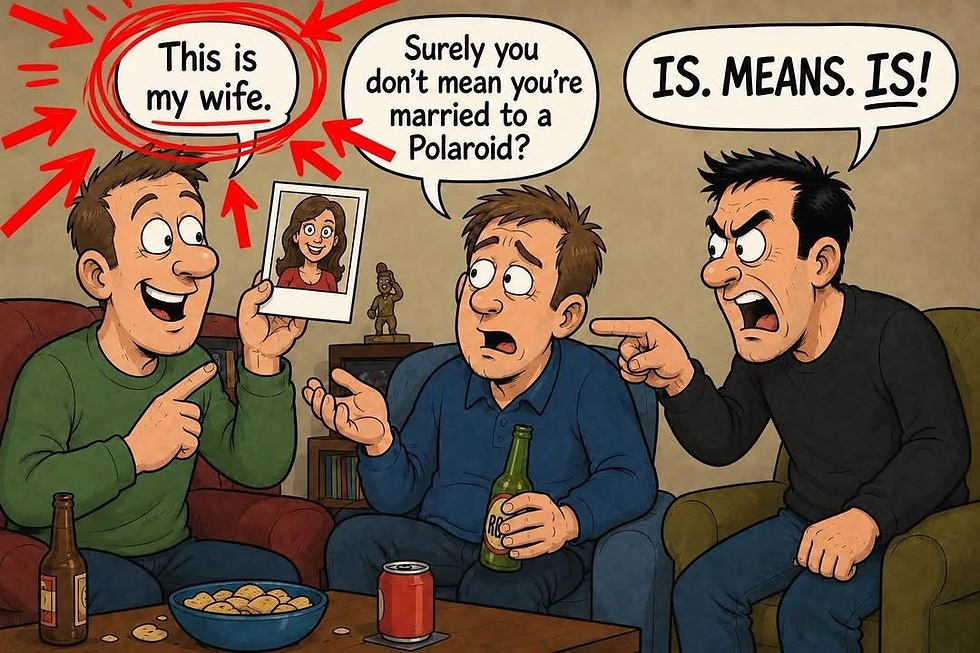
I contend the figurative application is actually the most natural understanding there is. Typically, we do not infer real presence from our application of "is", but rather, we determine our application of "is" from real presence. If a man wraps his arm around a woman and says to you "this is my wife", you interpret him literally because his wife is really present. If, by contrast, he holds up a photograph, you understand he is talking figuratively. Why? Because wherever the woman happens to be, whether in the next room, the next city, the next state, or even, God forbid, the next life, she is not really present. We all just naturally understand the distinction between "this literally is" and "this figuratively is". While one could theoretically go out of their way to remove all doubt by saying "this represents my wife", it's unnecessary to do so.
By contrast, the Real Presence is a unique understanding that is in no way analogous to how we understand any other symbol. The closest thing I can think of is an urn or a gravestone. In this case, we might say "this is my wife", and understand that the urn is not the man's wife, but because of the nature of an urn, she is really present in some form. But even here, this isn't a symbol being interpreted as though the thing it represents is literally present, but rather, the deceased wife is literally present, and if there was any doubt, there are some... ethically questionable, but physically possible ways to alleviate them.
Side note on John 6
It's very difficult to deny that symbolic interpretations existed very early on, and in fact, very explicit examples can be given. To give one of those examples, Tertullian writes "...‘This is My body,’ that is, the figure of My body." (Emphasis added) (1). In debate, however, I notice that many literalists, particularly Lutherans, argue that Memorialists anachronistically impose modern, Western understandings of "symbol" onto ancient texts. It is suggested that even when ancient writers explicitly said Jesus was speaking figuratively, that is not in conflict with them interpreting Him literally as well. In the meantime, they claim that first century Judaism was very much familiar with Real Presence-style symbolism, even to the extent of being practically unfamiliar with symbols apart from a Real Presence-style view.
Aside from the fact I can find no evidence (nor have I ever been shown any) that first century symbolism was radically different from modern symbolism, there is a contradictory argument from literalists themselves. They regularly argue from John 6 (which, ironically, is not necessarily Eucharistic). In verse 52, we read "The Jews therefore quarreled among themselves, saying, “How can this Man give us His flesh to eat?”" followed by the famous "this is a hard saying" in verse 60. But if they're already familiar with Real Presence-style understandings, why were they confused? Simply because this is not the kind of imagery they were used to. In fact, to consume blood, in a Jewish mind, was an abomination that cut one off from Israel, and set the very face of God against you (Leviticus 17:10-14). Consuming human flesh, while less explicitly condemned, is also presented as a result of a terrible curse levied for persistent rebellion against God's Law (e.g. Leviticus 26:27-29).
We see, then, that far from being something with which the Jews would have been perfectly familiar, it would have been even more alien to them than it is to Westerners. We are at the very least accustomed to traditions that have been developed over the centuries. These ideas have even shaped our culture! But to a Jew, it's not just that they didn't have a concept of a symbol being simultaneously literal, it's that they couldn't comprehend being literally asked to do something that their God-breathed Scriptures explicitly associated with horror, and condemned as an abomination.

This is especially the case for one Jew in particular. Peter was notoriously stubborn, beholden to his Jewish heritage, and frequently resistant to God's direct statements. When told that Jesus would die, Peter said it wasn't going to happen, so Jesus rebuked him and called him Satan (Matthew 16:21-23). Despite this, when they came to arrest Jesus, Peter took a sword and struck the high priest's servant (John 18:10). When Peter was told to kill and eat unclean animals in a vision, Peter resisted 3 times, saying "“Not so, Lord! For I have never eaten anything common or unclean.”" (Acts 10:9-16). We even see in Galatians 2:11-21, Peter was so concerned with his reputation among the Jews that he actively separated himself from the Gentiles. In so doing, he sinned against the Gospel itself!
With his personality, it seems to strain credulity that Peter would, without a hint of resistance, do what he considered to be literally drinking blood or eating human flesh. It is entirely reasonable to suggest that if anyone resisted the Real Presence, it would have been Peter. Yet, instead, it is from his mouth that we hear the words "Lord, to whom shall we go? You have the words of eternal life." (John 6:68).
We see, then, that even if we accept the Real Presence as the correct understanding of the text, it would still be a new understanding in the first century. It isn't something first century Judaism would have been readily familiar with, but rather, something that would make first century Jews flee from Jesus. Furthermore, when we consider the Scriptures, we could reasonably argue this would be justifiable, which Augustine actually did. Commenting on John 6:53, he wrote "This seems to enjoin a crime or a vice; it is therefore a figure, enjoining that we should have a share [communicandem] in the sufferings of our Lord, and that we should retain a sweet and profitable memory [in memoria] of the fact that His flesh was wounded and crucified for us." (2).
With all of this combined, it seems the claim that the ancient world had a radically different understanding of symbolism than we do exists primarily as an ad hoc defence against those who clearly held Jesus to be speaking figuratively, and to sustain the claim that the Real Presence was the historically unanimous view.
The Real Presence, however, is in no way similar to even a real-presence symbol like the aforementioned urn. It is so unique that it requires either an appeal to mystery (i.e. "I don't know how, but I believe it anyway"), or some contrived explanation for how Jesus' body is really, but not perceptibly present.
With God, the former approach is not necessarily a problem in and of itself. Scripture very clearly tells us "Trust in the Lord with all your heart, And lean not on your own understanding;" (Proverbs 3:5). So, if a literal teaching can be proven, but cannot be understood, it's ok to simply believe the literal teaching as something true, yet above our paygrade. There are many things in Scripture we don't fully understand, either as individuals, or even as a species.
The Trinity is a fantastic example of the latter. How is God triune? How does it make sense for 3 persons to be one God? I don't know, I just trust Him because that's what His word says, and this interpretation can be fairly easily proven. In the same way, if a literal interpretation of Communion could be proven, the appeal to mystery would be less fallacious. But the appeal to mystery assumes a literal interpretation has been proven, yet appealing to mystery is a defence of the literal interpretation. It is, therefore, circular reasoning.
As a further illustration, consider the fact that Jesus regularly spoke in ways no one takes literally today. For example, "I am the true vine, and My Father is the vinedresser" (John 15:1). I don't understand how Jesus could be a literal plant, but I also don't believe He is a literal plant. Thus, I don't need to appeal to mystery to defend the idea that He is a literal plant either. I am safe to take this obvious metaphor as the metaphor it obviously is. If I did interpret it literally, and then I started saying "am means am", that would be quite silly. It would be even sillier if I then appealed to mystery to defend my literal interpretation, and started claiming those who didn't interpret Him literally were being unfaithful to the text. In the same way, you don't start with "lean not on your own understanding" and use that to prove or defend an interpretation. Rather, you prove the interpretation first, then you appeal to mystery if necessary.
The contrived explanations for how the bread and wine could be Jesus' literal flesh and blood are more problematic. The appeal to mystery makes sense because it fits the general pattern of Scripture. But there is no example in Scripture in which we are expected to believe an imperceptible miracle. Yet, the real presence of a human body in bread is quite imperceptible. If it was real, it shouldn't be. But it is. So you have to make something up to explain why a piece of bread can literally become real human flesh, yet no one notices. That is, you invent a mystery that isn't presented in Scripture, then you attempt to solve the mystery by inventing a whole new understanding of how God's creation works with exactly no justification in His Holy word.
Ultimately, both options inadvertently confess that the Real Presence is an unnatural interpretation. In any other circumstances, we understand "this is" as literal when it is obviously literal, and as figurative when it is obviously figurative. That is, using the 5 senses God meticulously designed to enable us to perceive certain realities, even when He, Himself, has in some way altered that reality, we have the ability to distinguish, automatically, and without clarity, between a literal and symbolic "is".
Potential interjection
Literalists may argue that perceptibility is not a criteria for reality because God has created many things which are real, yet imperceptible, such as angels and demons. The Holy Spirit Himself, while uncreated, is also imperceptible, yet He is really present in us as His living temples.
With this in mind, it is true that not every reality, including God Himself, can be detected with the 5 senses. However, what we're dealing with here is Jesus' body, which absolutely is perceptible. In contrast with certain heretical groups, who posit Jesus as a phantom or other spiritual being, Jesus presented Himself alive by many infallible proofs (Acts 1:3). We see some of these proofs in other Scriptures. In Luke 24:36-43, He notes how a spirit does not have flesh and bones as He does, and asks for food and eats in front of witnesses. More famously, in John 20:24-29, Jesus has Thomas place his fingers in the wounds of His crucifixion, prompting the response "My Lord and my God!" (v28).
We see, then, that Jesus' body is fully human. The problem is, human bodies cannot become synonymous with bread, nor can bread become synonymous with human bodies. Thus, to claim the bread is literally His body is to confuse His human nature with His divine nature.
In short, because human bodies can be perceived, we are not talking about something that would be reasonably considered imperceptible. Therefore, we may logically surmise that if the Real Presence was true, it would be perceptible, and its imperceptibility disproves the Real Presence.
But hyperliteralists, even when presented with clear and undeniable examples, rarely admit any of this. Consider the header image. This depicts a previously mentioned example of man holding up a polaroid depicting a woman, announcing "This is my wife". His two friends, rather comically, interpret him literally. The first one questions him, "Surely you don't mean you're married to a polaroid?" The other friend rather obnoxiously rebukes him, asserting "IS. MEANS. IS."
The funniest thing about this meme is the simple fact that neither of the two reactions is natural. As discussed above, you're just not going to question whether or not the man means he is literally married to a polaroid. You would think, then, that this would be sufficient to illustrate the folly of the argument, and force hyperliteralists to find other ways to prove their view.
However, I recently found out the hard way just how committed some people are to the Real Presence. I posted the header image on the Bible Brain Facebook page with the following short commentary: "It’s true that “is means is”, it’s just that “is” has a wider range than is convenient for certain doctrines. There are many scenarios in which “is” naturally leads to a symbolic interpretation. The Last Supper, especially when combined with a Chalcedonian understanding of the Hypostatic Union, is one of them."
See how clear that is? Personally, I think the meme stands on its own merits even without the commentary. But with the commentary included, we have 4 key points to gnaw on:
A charitable concession: "It’s true that “is means is”".
A claim about how far that can go: "There are many scenarios in which “is” naturally leads to a symbolic interpretation."
An undeniable example of an everyday scenario in which "is" naturally leads to a symbolic interpretation (the meme itself).
An assertion that "The Last Supper, especially when combined with a Chalcedonian understanding of the Hypostatic Union, is one of them."
Clarification on "a Chalcedonian understanding of the Hypostatic Union"
In 451 A.D., the Council of Chalcedon produced a creed including the following assertions about the Hypostatic Union:
"...according to the Manhood; one and the same Christ, Son, Lord, only begotten, to be acknowledged in two natures, unconfusedly, unchangeably, indivisibly, inseparably; the distinction of natures being by no means taken away by the union, but rather the property of each nature being preserved, and concurring in one Person and one Subsistence, not parted or divided into two persons, but one and the same Son, and only begotten, God the Word, the Lord Jesus Christ..."(3).
If we assume this is an adequate interpretation of the Biblical data, which I contend it is, this poses a serious problem for a Real Presence interpretation. A Real Presence view requires certain statements to be made about Jesus' body that cannot be made of any other human body, usually by making an appeal to His divinity, and therefore confusing His two natures rather than recognising them as wholly distinct. Thus, Christ cannot be really present in the bread, for the same reason any other human body cannot be really present in the bread.
But the hyperliteralists who commented ignored all of this. No less than three of them, and a fourth via direct message, compared the whole post to Bill Clinton's famous "depends on what your definition of is is".
Notice the problem here. Rather than dealing with the very simple, very obvious, very undeniable, and now very prominently highlighted example I provided, they decided to compare my whole argument to the evasive sophistry of a sexual predator.
This response is so devoid of sound reasoning, and so outside the realm of respectful dialogue, that there is only one word I can think of to describe it. However, I did promise Jesus I would never use it on this ministry. So, rather than use the one word I am covenantally barred from using, allow me to instead use many words: If you have to ignore sound arguments, and compare the post in which they appear to the idle babblings of a pervert on trial, you're showing yourself to be a Proverbs 18:2 kind of fool, and have become disqualified for any adult conversation. You have abandoned charity, and therefore deserve no charity. You have abandoned reason, and are therefore marked as unreasonable. All cards on the table, this is a level of rhetoric that puts me in severe danger of committing the sin of pride.
But it also does something else. Ignoring the arguments leaves them entirely untouched. It means we have successfully proven, without contest, that "is means is" isn't the win the hyperliteralists think it is. And frankly, it would be fantastic if they could unanimously admit that.
In the interest of both charity, and sound reasoning, it's worth noting that this is not the same as conceding the whole debate. You can admit that your opponent has a good point without validating their view. You can also admit you have made a bad point without losing a hint of confidence in your own view. If hyperliteralists could do this with the "is means is" argument, I firmly believe the discussion would be instantly propelled a thousand miles, and we could finally discuss the specific meaning of this specific "is".
In the interest of contributing to that propulsion, let's do exactly that. We will assume the hyperliteralist has conceded that the "is means is" argument is dead, and that "is" does have a figurative application. Yet, they're still not convinced the figurative application is appropriate in the Eucharist. Here's why I think it is.
First, while the phrase "this is my body" is consistent across all accounts, "this is my blood" is not. By Paul's account (which closely mirrors the one found in Luke's Gospel), "For I received from the Lord that which I also delivered to you: that the Lord Jesus on the same night in which He was betrayed took bread; and when He had given thanks, He broke it and said, “Take, eat; this is My body which is broken for you; do this in remembrance of Me.” In the same manner He also took the cup after supper, saying, “This cup is the new covenant in My blood. This do, as often as you drink it, in remembrance of Me.” For as often as you eat this bread and drink this cup, you proclaim the Lord’s death till He comes." (1 Corinthians 11:23-26).
This is quite significant. If we have two different versions of the same speech, a maximum of one of them can be word-for-word accurate. That is, Jesus didn't say both "this is My blood of the new covenant" (Matthew 26:28; Mark 14:24) and "This cup is the new covenant in My blood" (Luke 22:20; 1 Corinthians 11:25). Now, if we were hardcore atheists, we could argue contradiction here. But as we're not atheists (unless you are, at which point I'm surprised you're even reading this article), we can safely conclude that there is a divine purpose for the word difference.
To determine this purpose, it's worth noting that 1 Corinthians is the earliest of the four accounts. It's typically dated to the mid-50s A.D., whereas the earliest date ascribed to the Gospels is typically 70 A.D. So, we can reasonably assume the early Church was originally familiar with the phrase "This cup is the new covenant in My blood". And of course, for the Corinthians themselves, we can flat out assert it.
What we can also assert, theologically speaking, is that whatever Jesus initially said, the Holy Spirit guided Paul to write as he did, "knowing this first, that no prophecy of Scripture is of any private interpretation, for prophecy never came by the will of man, but holy men of God spoke as they were moved by the Holy Spirit." (2 Peter 1:20-21, cf. 2 Timothy 3:16-17).
Aside from Paul's rendering being earlier, I would argue there is also significance in who wrote what. Luke's Gospel is more geared towards a Gentile audience, whereas Matthew's is the most Jew-oriented. Mark sits somewhere between the two, whereas Paul identifies himself as "...an apostle, and a teacher of the Gentiles." (2 Timothy 1:11 cf. Romans 11:3; Galatians 2:8). So, the two Jew-oriented books use one phrase, and the two Gentile-oriented books use the other. And I don't think that's accidental.
See, when we compare the two phrasings, it's interesting that they only really work one way around. If Paul and Luke's rendering is correct, Matthew and Mark's rendering is actually a fair and sufficient paraphrase. That is, it is entirely reasonable to state "This cup is the new covenant in My blood" as "this is My blood of the new covenant". This is especially the case if Matthew and Mark already assumed their readers would be familiar with Jewish Law and Paul's traditions. By contrast, Paul and Luke's rendering is a change in both order and content. So, in my opinion, it's more probable that Jesus said "This cup is the new covenant in My blood".
But even if we go the other way and assert that Paul is the one who changed the wording, we can again assume there is a reason for that. Specifically, maybe this was done to avoid confusing the Gentiles. In Biblical Judaism, to consume blood is an abominable act that results in societal ostracization, and sets the very face of God against you (Leviticus 17:10-14). So, no matter which phrase Jesus historically used, there's just no reasonable way a Jewish audience is going to interpret "this is my blood" literally, and even the most faithful Jew (like Peter) would have had an issue drinking it if they thought it was real blood.
But what about Gentiles? Well, first of all, Gentile is a very broad category. It literally means anyone who isn't Jewish. So that would include those whose religions literally involve drinking blood, even human blood. But even then, a Gentile might be more open to drinking blood than a Jew. In fact, the conclusion of the Jerusalem Council is that Gentiles should abstain from blood (Acts 15:20, 29), which is a strange conclusion if there's no risk.
So, there are two possibilities here:
A. Jesus historically said "This cup is the new covenant in My blood", and Matthew and Mark saw fit to paraphrase this for their Jewish audiences who would not be in any kind of danger of misinterpreting this, especially if familiar with the other rendering.
B. Jesus did actually say "this is my blood", but Paul and Luke saw fit to paraphrase it to avoid confusing Gentiles who might be more prone to a literal interpretation than Jews.
Either way, we have to deal with the fact that the renderings are different. Jesus may have said one or the other, but the Holy Spirit said both, and so we must factor both into our interpretation of Communion.
So, why is all of this significant? Simply because of the distance created by Paul and Luke's rendering. These do not identify the fruit of the vine (Matthew 26:29; Mark 14:25) as the blood of Christ, but rather, they identify the cup as the New Covenant in His blood. This not only dissipates the "is means is" argument entirely, but it tells us exactly what is meant. Namely, this is yet another figurative way in which Scripture points to the real blood Jesus shed for us for the remission of sins.
This is what literalists often miss. It's not just that it's an obvious symbol, it's a perfect symbol. If, as Scripture says, we do this in remembrance of Him, and in particular "...as often as you eat this bread and drink this cup, you proclaim the Lord’s death till He comes" (1 Corinthians 11:26), it just makes sense that we break bread in remembrance and proclaim the body He broke for us, and pour out wine in remembrance the blood He spilled for us. We aren't repeating that sacrifice. We aren't summoning Christ to be really present, because He is not really present (at least, not physically). We aren't transforming perishable food into the imperishable flesh of our Risen Lord. We are remembering, and proclaiming, the sacrifice from which we benefit eternally.
And so I think I've proven, beyond all reasonable dispute, that the "is means is" argument is dead. It is true that "is means is", but it is also true that "is" has a figurative application. It is also true that this figurative interpretation is natural, because we do not determine real presence from our interpretation of "is", but we determine our interpretation of "is" from real presence. This, I have demonstrated from three indisputable examples: "This is my wife" in the form of a real, tangible woman, "this is my wife" in the form of a polaroid, and "this is Grandpa" in the form of an urn. If the Real Presence is analogous to anything on this Earth that could reasonably lead a man to similarly interpret the bread and wine in a literal sense, I have never heard it, but I am open to it. Literalists, find it, send it over, and I'll add it to the end of this article. If it checks out, it will certainly force me to rethink my interpretation. Until then, it's clear that the Memorialist view of the Eucharist is vastly superior, because it conforms to the ordinary methods of interpretation.
References
AI usage
The Peter meme in the John 6 side note was created with ChatGPT.


Hey! Real presence guy here. Just curious, what do you do with 1 Corinthians 10:16, “Is not the cup of thanksgiving for which we give thanks a participation in the blood of Christ? And is not the bread that we break a participation in the body of Christ?” (NIV). Cup/wine - blood, bread - body, a “κοινανια” or “common sharing.” Just curious!