


Reading for dummies


One of the biggest obstacles to reasonable theological discussion is the way in which it is commonly shut down by reference to the interpretations problem. By nature, there is a disconnect between that which is interpreted, and those who interpret it. As a result, any written work will inevitably have a variety of interpretations, even if it was meticulously designed to be limited to only a few. Even if a book was perfect in every conceivable way, it would still suffer from the imperfect way in which fallible humans will inevitably use it.

According to our religion, the Bible is a perfect book. We believe that all Scripture is God-breathed (2 Timothy 3:16-17), and every word of God is pure (Proverbs 30:5). Yet, we also understand that we are very much not perfect. There are three essential elements to a perfect interpretation: Faith, knowledge, and integrity. If you don't believe the Bible, don't know what it says, or just aren't willing to obey it, you will inevitably misinterpret it. In some cases, that misinterpretation is even deliberate. The problem is, we are all imperfect regarding these three elements. We all fall short of the glory of God, and thus would fail to correctly interpret His pure words, even if He personally stood before us and spoke them out loud.
In the back of our minds, we all understand that this problem is a universal constant. Sadly, as a result, it also ends up being a universal cop out. No matter what you believe, or what the Bible says about it, you can divert the conversation away from it by simply pointing to the interpretations problem. This is used to draw any number of wrong, and ironically mutually exclusive conclusions. These include, but are not limited to:
The Bible is a useless book - the authors had a particular meaning in mind, but they were terrible communicators, so no one knows what their meaning actually was.
The Bible is actually totally clear, but no one really believes it, so they just use it for their own selfish ends.
The Bible is deliberately designed to be unintelligible, sort of like abstract art - your interpretation says more about you than you say about it.
The Bible has no discernible interpretation, and it's arrogant to believe yours is correct.
The Bible does have a true meaning, but only one organisation has the authority to declare what that actually is (conveniently the one to which the person making this claim belongs).
All of these malformed conclusions could be easily avoided if we acknowledged that while we, as a species, are not perfect communicators, we nevertheless are communicators. Just because an interpretation exists does not automatically make it valid, because when we come to a written text, there are only so many interpretations it was designed to sustain.
Figuring out what those interpretations are is not excessively difficult. The written word is a fantastic invention that allows communication over long distances, and over long periods of time. The thoughts present in one mind can be transferred wirelessly to another mind, all through the complex and specified way in which we mark certain surfaces. And it all starts with a simple letter.
Understanding letters
Letters are the base of any written language. Each of these symbols represent a small variety of sounds used in pronunciation. On their own, they tend to be quite ambiguous, versatile, and could arguably be meaningless. Certainly, extra details are required to find out if they have meaning, and what that meaning is.
In English, the easiest two letters to explain this are C and K. At the absolute base, these two letters perform the same function. However, the K lacks the ambiguity of the C. Or, to put it as comedian Mark Cooper Jones does, "Marcs with a C lack the solid dependability that the K offers. There's no debate with a K, it's a kuh sound. With a C, you have to decide, is it a K or an S sound?" Slightly further on in the act, he uses the cleaning brand Cilit Bang as an example. Is it Kill-it Bang, or Sill-it Bang?
But there are rules of interpretation that generally help us understand the pronunciation of a word, even if it is unfamiliar to us. It's not foolproof, but you will see the flaw of his question "Is it insect, or incest?" At least to my knowledge, there are no English words in which the "ct" spelling has an "st" pronunciation. So even if an English speaker had inexplicably never heard the word "insect", they would instantly understand how to pronounce it.
Because of the range of interpretation letters have, there aren't any specific examples I can give of where this comes into play in Biblical interpretation. Except, perhaps, to say that if the Bible was as ambiguous or unintelligible as certain people claim or imply, it would be just a random collection of letters. Thus, the fact that it is not disproves most of the statements listed above. The only one that can really be sustained is that the Apostles were bad communicators. But at that point, you're no longer in the realms of hermeneutics, you're basically an atheist, and this article ceases to be of any immediate use to you.
Understanding words
The aforementioned word "insect", or at least a synonym thereof, actually helps us understand the next level of interpretation: Words. Words are a lot less ambiguous than letters. Ironically, there are exceptions: "A" and "I" are single letter words, but they can have deeper meaning than their base form.
But other words, like "bug", have multiple letters, and multiple meanings. It can mean "insect", but what's particularly interesting here is that even here, the scientifically accurate and popular uses are different. The average person might call a spider a "bug", for example, but in the field of entomology, it is not. To be a true "bug", an animal must be a member of the order "Hemiptera", categorised by its piercing and sucking mouthparts.
Outside of biology, the word "bug" has a variety of other interpretations. It can mean a hidden recording device, or the action of placing such a device. It can mean to annoy. If you have a bug, it might mean you are sick. Sick with a bug, i.e. the micro-organism causing you the illness in question. If there's a bug in a computer system, that means something is wrong with it. You see, then, that this one word has a wide range of valid interpretations. Some of these are compatible, others are not.
In the Bible, even the word "god" is variable. It can of course refer to Yahweh, as it typically does. But in Exodus 12:12, when God promises to execute judgement against the gods of Egypt, He is certainly not confessing the existence of other divine beings. Rather, "god" can also apply to human rulers, demonic beings, and in our own language can even just mean someone who is excessively good at something. So, how do we know which use of the word "god" to apply?
Understanding sentences
This is where sentences come into effect. Words do not typically appear on their own, but tend to be surrounded by other words. A large collection of words form sentences. If an individual word has more than one plausible interpretation, a sentence can reduce them.
Continuing with the "bug" theme, the sentence "the frog ate a bug" reduces the number of plausible interpretations of the word "bug". Immediately, it narrows the scope to the nouns. The frog didn't eat the verb "to bug", because you cannot eat a verb. So, we're left with a few interpretations. However, they're not all equal, neither are they mutually exclusive.
First, what if the frog ate a cicada? Cicadas are insects in the order "Hemiptera", so it actually ate a bug in both the popular and scientific sense. This makes the interpretation that it ate a cicada entirely valid, and it technically means both interpretations of the word "bug" are correct. What about a spider? This is still a valid interpretation, because a spider is a bug in the popular sense. But the number of possible senses in which it is valid is reduced. If the sentence was "the frog ate a true bug", the spider interpretation would be automatically invalid (assuming the original sentence was written in English, and especially a biological textbook). Conversely, if the frog did eat a spider, anyone who argues it cannot have eaten a spider, or that it absolutely ate a true bug, is wrong.
This part opens a common talking point: What did Adam and Eve actually eat at the Fall? The forbidden fruit is commonly depicted as an apple, which many people even take for granted. The cartilaginous protrusion surrounding the larynx is even called the Adam's Apple in honor of this event. Yet, this is only a valid interpretation. The fruit could have been anything, depending entirely on exactly what species the tree of knowledge was. It's also worth noting that this is a self-propagating interpretation. When one group begins to understand the fruit as an apple, specifically, they will pass that interpretation on to the next generation. This next generation may even take the interpretation for granted, to the point where they are even surprised to discover it is not as solid as they had assumed. Sometimes, our interpretations of a text come from outside of said text, even before we read it - and this is a very important thing to keep in mind.
Another important note, while it is jumping the gun, is that this isn't really a dispute worth having. There is only one correct interpretation, but because Scripture as a whole leaves it open ended, we are stuck with a handful of valid interpretations that may or may not be correct. Yet, as long as we understand what is presented in Scripture, we have what we need.
With that in mind, let's return to our froggy friend. What if the frog actually ate a listening device? Going by the sentence alone, this interpretation is technically valid. Lacking extra context, it is also entirely possible. But this missing context is precisely what makes it less likely. We have good reason to doubt this interpretation by default.
As carnivores, frogs do tend to eat other animals, usually small invertebrates, i.e. bugs. Furthermore, a frog wouldn't typically be in a position to eat a surveillance device, nor would it likely be tempted to do so if it found one. Because the surveillance device is an unusual interpretation, we would expect context to be more specific in driving us towards it. This extra context may even alter the sentence itself, such as turning it into "the frog ate the bug". Balance of probabilities alone steers us towards the invertebrate interpretations.
Thus, a normal interpretation of "the frog ate a bug", which would be the default interpretation of the average reader, would be that the frog ate some kind of insect. A surveillance device wouldn't even enter most people's minds. While such an ironic twist would be plausible, it's not likely.
Just for fun... SCIENCE!!!!

In the process of writing this article, I decided to run an informal experiment. I published the example phrase "The frog ate a bug" with only one instruction: "Discuss." Naturally, I didn't expect anyone to take it seriously, but that might actually help my case. If people naturally load certain interpretations when they're trying to misinterpret it, they would surely hold these interpretations by nature also. Here are the results:
"Sorry I'm late to the party...Everyone rejoiced because the frog had been unwell of late and unable to digest food at all. The transformation that overcame him when he realised he had not been harshly treated by God after all and that it had just been a sore tongue, was a joy to behold. He was back to doing what frogs do. Now he felt safe and loved after all...I didn't see any insider info but at least I tried...Ο βάτραχος έφαγε ένα έντομο......καὶ εἶδεν ὁ θεὸς τὰ πάντα ὅσα ἐποίησεν, καὶ ἰδοὺ καλὰ."
"If we turn to the Greek, which says "ὁ βάτραχος κατέφαγεν τὸ ἔντομον" (ho bátrachos katéphagen to éntomon) we see the true flaw in your misguided understanding. The word used here for "ate" is κατέφαγεν, which is the same word we see in Luke 15:30 to describe the Prodigal Son who "devoured (καταφαγών) his wealth." We see it again when Jesus says "Zeal for your house will consume me" (John 2:17).
So as you can plainly see, the frog did not "eat" the bug anymore than did the Prodigal Son "eat" his wealth or zeal for God's house "eat" Jesus. This is merely a failing of the English translation. Instead, what we see is that the frog exhausted his resources (the bug), likely by being wasteful or neglectful in what was entrusted to him.
But I'm sure you'll say that's just my interpretation..."
"Literal or Metaphorical?
"The bass ate the frog""
"I don't know why, he swallowed that fly, I guess he'll die"
"Jason Statham......"
"Well, like the frog says, “Time’s fun when you’re having flies.”"
"This is blatant amphibiphobia. Reported."T
"High-Larious"
"No."
"No I didn't🤣"
I consider this experiment successful, as it theoretically demonstrates what was said above. As I included all the comments I saw, there are some that are essentially "useless", as in it's not really possible to see how the user interpreted the bug. That includes the page named "Freed Frog", who denied eating a bug, but didn't tell us what kind of bug she denies eating.
But notice, for some inexplicable reason, we got a reference to Jason Statham before anyone hinted at a surveillance device. Two people even specifically mentioned flies, likely because this is the kind of bug frogs are most known for eating. Interestingly, while "bug" is the word I've focused on for sake of this example, one of the commenters even shifted focus to the word "ate". Jokingly, of course, but even this ties in nicely to the next segment of this article.
Ultimately, this experiment demonstrates something bigger that I didn't initially think to include in this article, but I absolutely should have. That is the fact that even words with a vast array of meanings tend to have a default setting. In this case, when hearing "bug", it's not just certain contexts that drive people to think of invertebrates. They do it automatically, until context suggests otherwise.
This ties in to one of the biggest disputes of our era: The origins debate. It has become very popular in the modern day to compromise on origins, with compromisers seeking any excuse to crowbar millions of years into the creation account - if they even believe it is more than purely mythological. One of those methods is to point out that the word "day", or "yom" (יום) in Hebrew, has more than one interpretation. And it does.
However, the default interpretation is a 24 hour period, punctuated by evening and morning. Ironically, try though they may, compromisers can't escape this even when discussing the events. When I say I believe the Lord created everything in 6 days, you immediately know I'm a Creationist, I don't have to clarify my meaning. By contrast, a compromiser is unlikely to even say they believe God created in 6 days, and will always follow up with a clarification when they do.
In other words, Creationists are generally comfortable using the Biblical terminology here, because it is an accurate summary of the beliefs we are accurately basing upon this terminology. Compromisers, by contrast, avoid, alter, and even outright deny Biblical terminology because of the way in which it lends itself to our position over theirs.
Because of the default interpretation of "day", context is required to sway us away from it, just as the default interpretation of "bug" would require context to sway us from that. Ironically, adding extra context only makes non-literal days harder to sustain, as Scripture specifies that the days of creation had evenings and mornings. Later on, in the 10 commandments, God even ties the doctrine of the Sabbath to His creative actions, meaning however we interpret the 6 days of the Jewish work week, we should also interpret the 6 days of creation. But at this point, we're going far beyond the intended scope of this article.
Understanding paragraphs
So, how do we get the context that might help us understand our sentence? By looking at other surrounding sentences. When multiple sentences are combined, they form what's called a "paragraph", which again tends to reduce the number of valid interpretations.
Here's where things start getting interesting. Let's suppose the paragraph in question contains the phrase "I didn't say the frog should eat a bug." On its own, this sentence actually has a wider variety of interpretations than "the frog ate a bug". This variety depends on which word is emphasised. This part will be tedious, but please bear with me while I demonstrate. For sake of argument, we'll assume the sentence was spoken by a character named Bill.
"I didn't say the frog should eat a bug."
This emphasis denies Bill said the frog should eat a bug, but leaves it open to deflect blame or credit. We could re-state this as "I wasn't the one who said the frog should eat a bug". But maybe Bill intends to direct the blame towards Ben.
"I didn't say the frog should eat a bug."
This turns the sentence into a more rigid denial, with fewer implications of deflecting blame. Rather than "I wasn't the one who made the statement", Bill could be claiming the statement was never made. It's worth noting, however, that blame could still be in the background. This makes this interpretation different, but compatible, with the first.
"I didn't say the frog should eat a bug."
Emphasising "say" is more compatible with acceptance than denial. Rather, it is the specifics of the action that are being denied. Bill could have implied the frog should eat a bug, or maybe even wrote it, but didn't outright say it.
"I didn't say the frog should eat a bug."
Once again, Bill has accepted responsibility, but this time has also accepted the action. Now, however, he has also indicated the presence, or at least existence, of other frogs. Interestingly, the frog in question may even be hypothetical. If, for example, Bill said "a hungry frog should eat a bug", he might not be aware of a specific frog. Then a hungry frog pops out of the bushes and eats a bug, so now Bill can deny saying the frog should eat a bug.
"I didn't say the frog should eat a bug."
The emphasis on "frog" reduces the likelihood the frog is hypothetical, but Bill is denying he had it in mind when he made the relevant statement. Perhaps he said the lizard should eat a bug. Maybe the cat, the dog, or if you want to be silly maybe the TV remote, should eat a bug. Anything but the frog.
"I didn't say the frog should eat a bug."
Now we're returning back to a specific frog, but the dispute is now about what Bill said the practical or moral implications of said frog eating a bug. Perhaps he stated it as an objective fact. "The frog will eat a bug." This is a descriptive statement, whereas "should" makes the statement prescriptive.
"I didn't say the frog should eat a bug."
Bill is now implying he said the frog should do something different to a bug. Chase it, hug it, pay it, hide it (which would actually lend itself more to the surveillance device interpretation), anything but eat it.
"I didn't say the frog should eat a bug."
Now we've moved on to Bill accepting responsibility for saying something about what the specific frog should eat, and that this, in some way, relates to a number of bugs. But how many bugs did he say the frog should eat? Just one? This is actually plausible. "A" is a singular word, but so is "the". "A", however, is not as specific as "the". So, if Bill said "the frog should eat the bug", it would still be a singular bug, it would just be a more specific statement. However, because Bill is denying he said the frog should eat a bug, he could also have said the frog should eat multiple bugs.
"I didn't say the frog should eat a bug."
Finally, having accepted full responsibility for having said something about what the frog should eat, Bill is now disputing what, specifically, that was. It could have been a banana. A steak. Maybe a Snickers bar (he's not a frog when he's hungry). But he's denying it was a bug. In fact, ironically, he could even follow it up with "I said the frog should eat a bug", and that wouldn't be as contradictory as it appears at first glance. Even without the italics or boldness, the mere repetition is enough to help us figure out which word to emphasise. In this scenario, the emphasis cannot reasonably be on "I", or "didn't", because these are both denying he made the relevant statement, whereas the follow up is a confession that he did. But he was talking about two different kinds of bug.
A popular example in Biblical interpretation is Proverbs 26:4-5, which says "Do not answer a fool according to his folly, Lest you also be like him. Answer a fool according to his folly, Lest he be wise in his own eyes." Atheists sometimes present this as inherently contradictory, and even faithful Christians sometimes struggle to understand exactly how to apply these seemingly conflicting sentences. Yet, the answer is fairly simple: The emphasis needs to be placed on both "answer", and "according to".
To help understand this, let's draft an alternative: "Do not answer a fool with a statement, answer a fool with a question." Even having removed the reasoning for why a question is better than a statement, I've made it fairly clear that I'm talking about the type of answer I want you to give, not whether to answer. It's the same principle here, with the reasoning explained: Do not answer according to his folly, lest you also be like him. So, if a fool comes at you with insults, don't use insults. But if you don't answer him at all, he's going to be wise in his own eyes. So you answer him according to his folly. That is, as his folly deserves.
Understanding verses
Having established all of the above, we have a pattern that can be followed even before finishing this article, as by now you should be able to see that all we're doing is scaling up an extremely simple principle, which can be summed up in one word: Context. Context is information which is sufficiently related to a given text as to help understand its meaning. It's a very important word, which you'll hear a lot in theological debates, particularly when it comes to a disputed Bible verse.
This is often the key to responding to the interpretations problem. When people say "there are so many interpretations of Scripture", what they often mean is there are so many interpretations of individual Bible verses. This tends to be scaled up until you end up with denominations.
Ironically, this, in itself, disproves the very point the interpretations problem is used to make. If Scripture really was the problem, we would expect to see this much division, but we wouldn't expect to see this much unity.
As we've shown throughout this article, sometimes, it genuinely is possible for some Bible verses to have more than one plausible interpretation. This is partly by design. The Bible was never intended to reward those who are too lazy to study it, and in fact, we are explicitly commanded to do so (2 Timothy 2:15). Interestingly, the longest chapter in the entire Bible is Psalm 119, consisting of 176 verses. The topic of this Psalm is the importance, and benefit, of diligently studying God's word. This, it portrays not merely as a moral obligation for Christians, nor as a chore for those specifically pursuing ministerial careers, but as a great treasure. It's also what this ministry's tagline is based on. "We are the simple the Psalmist talks about" draws directly from Psalm 119:130.
But if there are several plausible interpretations of a Bible verse, and it requires diligence to figure out which is the most plausible, how do we go about that? Well, first, it's important to note that Scripture doesn't contain verses. What do I mean by that? If you've been paying attention, you might be able to figure it out yourself. If not, allow me to eliminate a few plausible interpretations: Bible verses are not an original feature of Scripture. These artificial dividers were added later, for ease of reference. They tell us where the Bible says certain things, but are not intended as interpretive guides for what it says.
With that out of the way, first, to understand context, we use the principles already discussed. We narrow the meaning of each word according to the context of the sentence in which it appears. We narrow the meaning of each sentence by the context set by the relevant paragraph. So on and so forth. With each rung on the ladder, more context is added, reducing the number of plausible interpretations.
Before moving on, it's important to note that, especially when dealing with topics like this, not every existing interpretation is plausible. This is where we get into exegesis vs. eisegesis. Exegesis is the practice this article is designed to encourage: The act of forming an interpretation on the basis of a text. "This is what the text says, therefore I shape my views accordingly."

Eisegesis is the exact opposite. It begins with a preconceived idea of what the text should say, then seeks support for it. While eisegesis is not always deliberate, it is always inherently invalid. This is especially the case when it is being used to support something that is contrary to the text. It is technically possible to practice eisegesis in a way that is compatible with the text, such as finding the Trinity in a verse that doesn't technically support it. More often, however, it is done intentionally, to support a heresy.
Eisegesis often comes in two forms: Creating a prooftext, or responding to one. A prooftext, as the term suggests, is a text that is used to prove a particular conclusion.
An example of an artificially created prooftext is 2 Peter 3:8. 2 Peter 3:8 says "But do not overlook this one fact, beloved, that with the Lord one day is as a thousand years, and a thousand years as one day." This is ironically interpreted literally, in order to prove the days in the Genesis creation account are not literal. Even more ironic is the fact that verses 4-7 describe the exact kind of heretic, apostate, or even unbeliever, who would be tempted to twist 2 Peter 3:8 in this way. Furthermore, the entire context set by 2 Peter 3:1-10 shows that this passage is not about the beginning, but the end. It's about the return of Christ, and why He appears to be taking so long to return. From man's perspective, He's being slow. From His perspective, He's being patient.
An example of a legitimate prooftext is Isaiah 43:10, which says "“You are my witnesses,” declares the Lord, “and my servant whom I have chosen, that you may know and believe me and understand that I am he. Before me no god was formed, nor shall there be any after me." This, along with other Scriptures, proves Absolute Monotheism, necessarily invalidating any religion that claims other gods existed, exist, or will exist. Mormonism is one such religion, but because it claims to be Christian, it must deal with Isaiah 43:10 in a way that doesn't involve flat out denial. One of the ways Mormon apologists do this is to suggest God is only talking about gods we need to concern ourselves with. There were gods formed before Him, but we don't need to worship the god He worshipped when He was a man, nor will we worship the Mormons who achieve Godhood when that time comes.
Neither of the above are valid interpretations, simply because they are not designed to be valid interpretations. This intention, in and of itself, is sufficient to discount them, even before context is added.
But context should always be sought, as it's very rare for a verse to sufficiently stand on its own. There's even a saying, "never believe a Bible verse", precisely because a Bible verse can be interpreted in many different ways - legitimate, and illegitimate. So, what do we do? If you guessed "seek context"... you don't get a cookie. The answer is correct, but obvious.
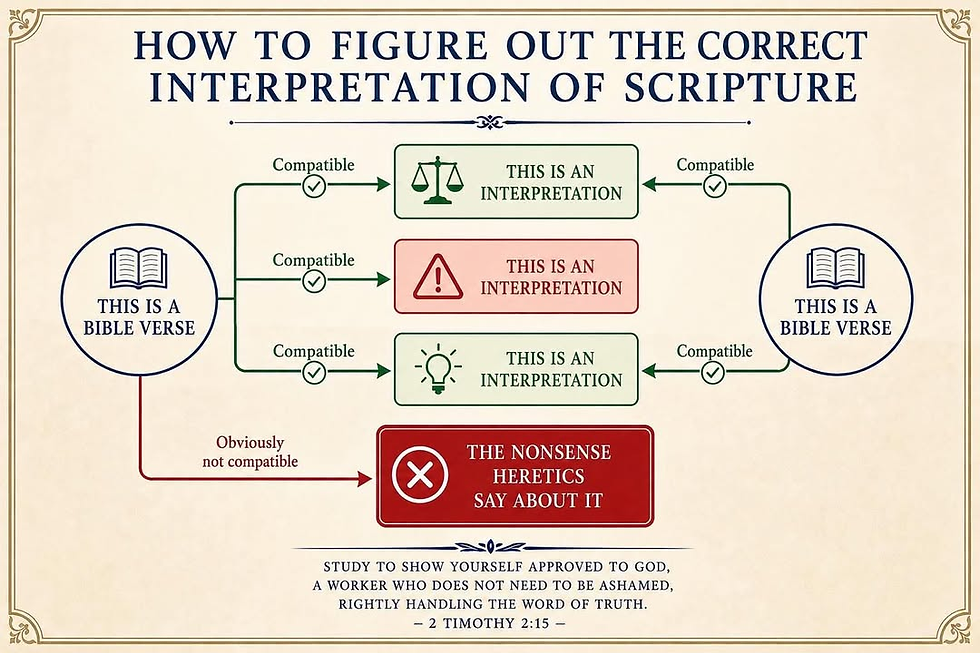
But let's go a bit deeper. How do we seek the context? It's fairly simple: Read more. As we've said repeatedly throughout this article, more context = fewer plausible interpretations. This can be seen in this diagram. Here, we have two Bible verses with different interpretations. The first verse has 4 interpretations, the second has two. But notice, the two stemming from the second verse are only compatible with two interpretations of the first. The heretical interpretation, as in the above two examples, has been excluded by default. We don't need to entertain, much less accept an interpretation that isn't based on sincere exegesis.
But the context set by the second Bible verse has eliminated a plausible interpretation of the first. We now see that this interpretation, while initially plausible, has been invalidated, not because it doesn't fit the original verse, but because it doesn't fit the second.
Understanding chapters
This is where we scale up our literary concepts again. So far, we've looked at ambiguously large concepts with no clear boundaries. One typical boundary is chapters. After each chapter, verses reset to 1. Chapters can be self contained, and some books even have only one chapter. Because the chapter divisions are not original, nor inspired, it's not the best idea to assume they're interpretive guides, but they often group information according to context.
Often, the relevant context by which to interpret a verse - or verses - is found within the same chapter. An example I deal with regularly on this ministry is John chapter 6. This is often used as a prooftext for the Real Presence, which is a belief that is held by many denominations - particularly those linked to Roman Catholicism. But it's important to notice where Sacramentalists choose to begin and end their citation. Typically, they'll begin around verse 41, and end at verse 62, highlighting particular statements within this block. This is actually eisegesis, yet it actually appears plausible, simply because some of the statements are somewhat compatible with the Real Presence - like "the frog ate a bug" seems compatible with the surveillance device interpretation.
But then we factor in the rest of the chapter, particularly verses 26-40, and verses 63-71. These verses give essential context to verses 41-62, and they are not compatible with the Real Presence interpretation. Rather than rehash this in great depth, I'll link to my article "Mixing Metaphors", which is one of several articles in which I've dealt with this passage.
Understanding books
But of course, not all context is confined to a single chapter. Further up the chain, we have "books". Books are the largest self-contained sources of context. Sometimes these are literal books, like Genesis, but there are also epistles that we just call "books", like Jude. Unlike chapters and verses, books are generally inspired limits (though there are exceptions), and this is far more helpful for determining the context of their contents.
A great illustration of this is the first four verses of Luke's Gospel. Here, we read "Inasmuch as many have undertaken to compile a narrative of the things that have been accomplished among us, just as those who from the beginning were eyewitnesses and ministers of the word have delivered them to us, it seemed good to me also, having followed all things closely for some time past, to write an orderly account for you, most excellent Theophilus, that you may have certainty concerning the things you have been taught."
This sets the overall context of Luke's Gospel. It tells us that the whole book is intended as a historical narrative designed to give Theophilus certainty about Christian doctrine, even if the verse we are trying to interpret is found beyond chapter 1. This doesn't actually rule out the use of figurative language, but it does rule out the idea that we can constantly assert metaphor. When Luke talks about Mary being visited by Gabriel, for example, this isn't a poem. It really happened.
But what about the next chapter when we read "In those days a decree went out from Caesar Augustus that all the world should be registered"? With the context of Luke, we do have to take this as a historical event. Yes, it really happened. But what authority did Caesar Augustus have to register all the world?
Here, we come full cycle back to the word level. Specifically, in this case, the word "world" has more than one meaning. It can mean the planet, or indeed the human population of the planet. But it also has several, more localised meanings. In this case, it means the region over which Caesar Augustus had jurisdiction.
Understanding canons

Ok no, not that kind of canon. Though once again, we now have an example of a word with multiple meanings, the correct one being discovered by context. In this context, a canon is a group of works belonging to the same collection. As Christians, we believe "All Scripture is breathed out by God and profitable for teaching, for reproof, for correction, and for training in righteousness, that the man of God may be complete, equipped for every good work." (2 Timothy 3:16-17).
The phrase "all Scripture" tells us this statement applies beyond the book in which it appears. In fact, a few verses earlier, Paul has already alluded to Scriptures with which Timothy had been familiar since his youth (v14-15). In 1 Timothy 5:18, Paul had also identified Luke's Gospel as Scripture. In 2 Peter 3:16, Peter had similarly identified Paul's writings as Scripture.
These, in themselves, are canonical works which help us understand other canonical works. Not everyone claiming to be Christian believes 2 Timothy 3:16. Some will misquote various verses within 1 Corinthians 7 (also written by Paul) to say that actually, some Scripture is just his opinion, and can be safely dismissed in the same way as we might dismiss the Church "Fathers". In reality, even though 2 Timothy and 1 Corinthians are separate epistles, they both belong to the same canon. Thus, they give context to one another. The context provided by 2 Timothy 3:16 is utterly incompatible with the idea that some Scripture is easily dismissed as human opinion. Therefore, nothing in 1 Corinthians 7 can mean this either, and we can dismiss this as heresy.
As far as internal context goes, the canon provides the broadest literary context. If there's a verse you're struggling with, you will almost certainly be able to find something within the canon that will guide you to the true meaning.
Almost.
When it comes to things you actually need to know, you will find what you need within the Biblical canon. If every other written work on Earth was destroyed and forgotten, the Christian faith would survive, in its entirety, as long as the Bible was preserved. But there are some more obscure statements within it that could be confusing without extrabiblical context.
For some things, this is obvious. The Bible talks about a plethora of different animals, but doesn't describe many of them. An example from my own faith is the hoopoe. You might already know what this is, but when I first discovered it in Scripture, I had no idea. And Scripture doesn't explain what it is, it just says the Jews weren't supposed to eat it. Thus, I had to look it up outside the Bible.
Perhaps even more frustrating is the fact that animals don't translate very well. Some will likely remain constant until the return of Christ. Cows, lions, sheep, none of these are in danger of confusing future generations. But there's a reason people debate the identity of the mighty Behemoth of Job 41. Is it an elephant? Probably not. A hamster? Impossible. A dinosaur? I contend this is the most likely candidate, but there just isn't enough information to prove it. Its true identity has been lost to time. Thankfully, we don't need to correctly identify it to understand the message God intends to convey from it, but as far as that identity goes, Scripture isn't sufficient to figure it out. And sadly, unless we discover some ancient documents, complete with detailed illustrations, nothing ever will be.
Beyond this, there are other less important details that Scripture doesn't illuminate. For example, in John 10, Jesus is shown to celebrate the "Festival of Dedication". That is, Hannukah. Scripture doesn't explain what this is, or where it came from. For that, we have to turn to a book called 2 Maccabees. This was written during what's called the "Intertestamental Period", or more colloquially, the "Silent Years". That is, the period after Malachi, during which prophets ceased to appear in Israel. Ironically, we get a hint of this from 1 Maccabees 9:27, which could be considered "canonical" to 2 Maccabees. At the very least, these two works are sufficiently related to set each others' context. However, they are not divinely inspired, and thus are not a part of the Biblical canon (though that is a discussion for another article).
Many other external sources can be similarly useful to helping understand Scripture at higher levels. These are always lesser, but rarely useless. In some cases, even hostile works can be helpful. For example, Josephus was a non-Christian Jew, yet he is a contemporary of the Apostles, being born only shortly after the resurrection. Thus, he was in a decent position to observe the early Church, and document what they believed. Nothing he wrote can reasonably alter doctrine, but he can still give useful insights into the early Church.
Conclusion
You see, then, that when people bring up the interpretations problem, they are often making a mountain out of a molehill. But with the principles described in this article, it shouldn't be too much of an issue to deal with whenever it rears its ugly head. Sadly, because it is such an effective tool, the devil will likely never cease to use it. But the Sword of the Spirit will always be sharp enough to disarm him - if it is wielded correctly. This article will hopefully have trained you to do so effectively, cutting the number of interpretations down to a manageable level. At the very least, you need not fear being blown around by every wind of doctrine, and you should be able to spot false doctrine before it spots you.
AI usage
The header image was generated by ChatGPT.
The "perfect book" image was generated by ChatGPT.
The triangular diagram was generated by ChatGPT.
The exegesis vs. eisegesis image was generated by ChatGPT.
The "how to figure out..." diagram was generated by ChatGPT.
The canon image was generated by ChatGPT.


Comments