


Mixing metaphors: A twist on the Eucharist and our second birth


A Catholic recently asked me to explain what exactly it means to be "born again", as Jesus discusses with Nicodemus in John 3:3-8. I felt it would be appropriate to answer publicly.
Because Christ our Redeemer said that “Most assuredly, I say to you, unless one is born again, he cannot see the kingdom of God”, it has always been the conviction of the Church of God, and this ministry now declares again, that by the consecration of the baptismal font there takes place a change of the whole substance of the bath into the substance of the womb of our mother, and of the whole substance of the water into her placenta. This change the holy Catholic Church has fittingly and properly called transubstantiation."
I sincerely hope my readers fully understand that I didn't mean a word of that. It was a joke, and probably not one I would be able to deliver with a straight face in real life. But the joke has a point. Its foundation is a very real quote from the Catechism of the Catholic Church. Specifically, paragraph 1376:
"The Council of Trent summarizes the Catholic faith by declaring: "Because Christ our Redeemer said that it was truly his body that he was offering under the species of bread, it has always been the conviction of the Church of God, and this holy Council now declares again, that by the consecration of the bread and wine there takes place a change of the whole substance of the bread into the substance of the body of Christ our Lord and of the whole substance of the wine into the substance of his blood. This change the holy Catholic Church has fittingly and properly called transubstantiation.""
Notice how well my joke correlates to the actual teaching of the Catholic Church. I obviously had to remove the part about the Council of Trent, and changed "this holy Council" to "this ministry", but that is the most significant alteration I made to the logic. These changes were made so that it would seem as if I was giving my own opinion, rather than instantly give away that I was parodying Rome's opinion of the Eucharist. The rest, I kept consistent with the quote. Even my contorted application of the term "transubstantiation", while doctrinally strained, is logically consistent.
See, following the Great Eucharistic Controversy in the 9th century, Fourth Lateran Council (1215 A.D.) codified the view that the bread and wine literally become the flesh and blood of Christ, though without further elaboration on exactly how. In the ensuing centuries, however, Aristotelian metaphysics once again entered Western Europe. In Aristotle's view, there were two categories of identity: "Substance" (what a thing is), and "accidents" (the attributes it possesses). Thus, Catholic theologians such as Thomas Aquinas began using these terms to describe the Eucharist. The bread and wine retain their "accidents", appearing to be bread and wine in every tangible sense, yet their "substance" has been changed into the real, historical flesh and blood of Christ.
All my joke does is apply the identical logic to what it means to be "born again". The "accidents" of the baptismal font, bath, river, or whatever, remain. The "substance", however, becomes a literal, placenta-filled womb. This is obviously not what Jesus actually meant, but He was a man of many metaphors.
And when I say many metaphors, I mean many metaphors. He described Himself as the "true vine" (John 15:1), though neither of His dual natures are plant matter. He described Himself as "the door" (John 10:9), though He is certainly not a door. And all of this is before I start bringing up parables and strong teachings. The simple fact is, it's harder to find an example of Jesus speaking plainly than figuratively. In fact, when He finally did speak plainly, the Apostles were actually surprised. Observe John 16:25-30: "“These things I have spoken to you in figurative language; but the time is coming when I will no longer speak to you in figurative language, but I will tell you plainly about the Father. In that day you will ask in My name, and I do not say to you that I shall pray the Father for you; for the Father Himself loves you, because you have loved Me, and have believed that I came forth from God. I came forth from the Father and have come into the world. Again, I leave the world and go to the Father.” His disciples said to Him, “See, now You are speaking plainly, and using no figure of speech! Now we are sure that You know all things, and have no need that anyone should question You. By this we believe that You came forth from God.”"
Why did Jesus do this? He actually doesn't leave us too much in the dark here. We read in Mark 4:11-12 that "...He said to them, “To you it has been given to know the mystery of the kingdom of God; but to those who are outside, all things come in parables, so that ‘Seeing they may see and not perceive, And hearing they may hear and not understand; Lest they should turn, And their sins be forgiven them.’ ”". And again, in Luke 8:10, "And He said, “To you it has been given to know the mysteries of the kingdom of God, but to the rest it is given in parables, that ‘Seeing they may not see, And hearing they may not understand.’".
So why didn't Jesus speak plainly? In fulfilment of Isaiah 6:8-10, He specifically spoke in parables to deprive the Jews of understanding, lest they turn and be forgiven and healed. And that leads us into an entirely different discussion about judicial hardening, reprobation, and all sorts of other things that would have us discussing soteriology rather than the Eucharist. What we need to know for now is that Jesus rarely spoke literally during His ministry, and that ironically, this means those who do interpret Him with rigid literalism are similarly deprived of understanding.
For this reason, we can dismiss Catholic interpretations of John 6, where Jesus says things like "For My flesh is food indeed, and My blood is drink indeed. He who eats My flesh and drinks My blood abides in Me, and I in him." (v55-56). This, of course, they link to the Eucharist, suggesting that it is the one place Jesus' teaching must be taken with wooden literalism. They even point to the fact that many disciples left Him after this event, asking why He didn't stop them if He wasn't speaking literally?
But the passage itself explains the whole thing! Let's read a little further, past the part Catholics usually acknowledge:
"When Jesus knew in Himself that His disciples complained about this, He said to them, “Does this offend you? What then if you should see the Son of Man ascend where He was before? It is the Spirit who gives life; the flesh profits nothing. The words that I speak to you are spirit, and they are life. But there are some of you who do not believe.” For Jesus knew from the beginning who they were who did not believe, and who would betray Him. And He said, “Therefore I have said to you that no one can come to Me unless it has been granted to him by My Father.” From that time many of His disciples went back and walked with Him no more." (v61-66, emphasis added).
Notice the parts I have emphasised. To begin with, I have highlighted Christ's own interpretive guide. He is explicitly telling us the nature of the words He spoke. And lest Catholics suggest, as they often do, that this is a modern interpretation, consider the following words of Tertullian:
"They thought His discourse was harsh and intolerable, supposing that He had really and literally enjoined on them to eat his flesh, He, with the view of ordering the state of salvation as a spiritual thing, set out with the principle, It is the spirit that quickens; and then added, The flesh profits nothing — meaning, of course, to the giving of life. He also goes on to explain what He would have us to understand by spirit: The words that I speak unto you, they are spirit, and they are life. In a like sense He had previously said: He that hears my words, and believes in Him that sent me, has everlasting life, and shall not come into condemnation, but shall pass from death unto life. Constituting, therefore, His word as the life-giving principle, because that word is spirit and life, He likewise called His flesh by the same appellation; because, too, the Word had become flesh, We ought therefore to desire Him in order that we may have life, and to devour Him with the ear, and to ruminate on Him with the understanding, and to digest Him by faith." (1)

Notice he said a lot of what I just did, but without the lens of modern translations, Reformed creeds, or even, I dare say, the very existence of the Catholic Church. In his view, the disloyal among the disciples genuinely thought He was speaking literally (which we see in verse 52). However, he interprets verse 63 as the negation of this ludicrous interpretation.
Furthermore, he wisely points back to what Jesus had said earlier in the text. Specifically, starting from verse 26, up to around verse 40, we read "Jesus answered them and said, “Most assuredly, I say to you, you seek Me, not because you saw the signs, but because you ate of the loaves and were filled. Do not labor for the food which perishes, but for the food which endures to everlasting life, which the Son of Man will give you, because God the Father has set His seal on Him.” Then they said to Him, “What shall we do, that we may work the works of God?” Jesus answered and said to them, “This is the work of God, that you believe in Him whom He sent.” Therefore they said to Him, “What sign will You perform then, that we may see it and believe You? What work will You do? Our fathers ate the manna in the desert; as it is written, ‘He gave them bread from heaven to eat.’ ” Then Jesus said to them, “Most assuredly, I say to you, Moses did not give you the bread from heaven, but My Father gives you the true bread from heaven. For the bread of God is He who comes down from heaven and gives life to the world.” Then they said to Him, “Lord, give us this bread always.” And Jesus said to them, “I am the bread of life. He who comes to Me shall never hunger, and he who believes in Me shall never thirst. But I said to you that you have seen Me and yet do not believe. All that the Father gives Me will come to Me, and the one who comes to Me I will by no means cast out. For I have come down from heaven, not to do My own will, but the will of Him who sent Me. This is the will of the Father who sent Me, that of all He has given Me I should lose nothing, but should raise it up at the last day. And this is the will of Him who sent Me, that everyone who sees the Son and believes in Him may have everlasting life; and I will raise him up at the last day.”" (Emphasis added).
This vital context is typically omitted by Catholic apologists, and it's not hard to see why. Not only is it inconvenient for those who insist on taking the passage literally, but it presents the Gospel Roman Catholicism has explicitly anathematised! Notice the parts I have emphasised. The work of God is our faith in Christ, and when we have that faith, He gives us eternal life, and we will by no means be cast out. I'd say it could not be clearer, but of course it could, and elsewhere in Scripture, it is. But suffice to say for now, Tertullian's assessment is correct. In saying "The words that I speak to you are spirit", He is explicitly denying that they are literal. And His prior words explain exactly the spiritual teaching He intends us to understand.
But then why not re-claim His disciples by explaining this? Well, the first thing to note is it's not entirely impossible that He did. Notice Jesus' words on the cross, where He cried out "...“Father, forgive them, for they do not know what they do.”..." (Luke 23:34). We can combine this with 1 Corinthians 2:7-8, which says "But we speak the wisdom of God in a mystery, the hidden wisdom which God ordained before the ages for our glory, which none of the rulers of this age knew; for had they known, they would not have crucified the Lord of glory." From this, we see that God, in His wisdom, can blind and unblind anyone He so desires, for His own glory. Remember, it was the crowds who initially asked for Jesus to be crucified (Matthew 27:22-26), which of course they wouldn't have done if they had known who He was.
But after this? There is absolutely no sane reason they could not have come to faith. In fact, there are very clear parallels. During His ministry, Jesus' own brothers do not believe Him (John 7:5), and even believe He is out of His mind (Mark 3:21). Yet, after the resurrection, at least two of His brothers convert. Why, then, would it be impossible for God to answer His prayer to forgive the ignorant fools who crucified Him, or for at least a portion of those who left Him in John 6 to later return?
But even ignoring that, you may notice when I quoted verses 61-66, I emphasised more than just the "words are spirit" thing. I also highlighted "For Jesus knew from the beginning who they were who did not believe, and who would betray Him. And He said, “Therefore I have said to you that no one can come to Me unless it has been granted to him by My Father.”" So why did Jesus let them go? He gave the exact reasoning in the text! There were some there who did not believe, because it had not been granted to them to believe by the Father. They had been hardened in the Isaiah 9:8-10 sense.
We see, then, that there is absolutely no feasible way to interpret John 6 literally. Ironically, one could dispute if it is even directly connected to the Eucharist, but whether we connect the two or not, the simple fact is, to eat His flesh and drink His blood is always metaphorical. It is exactly as metaphorical as "you must be born again."
But that leaves us with the original question: what does it actually mean to be born again? I began this article with the pretext of explaining it, but I have instead spent 20 paragraphs discussing the nature of the Eucharist. It almost seems like a red herring. But as irrelevant and disconnected as the two discussions seem, it's worth doing this, for many reasons. To start with, let's read the passage the Catholic originally asked about:
"Jesus answered and said to him, “Most assuredly, I say to you, unless one is born again, he cannot see the kingdom of God.” Nicodemus said to Him, “How can a man be born when he is old? Can he enter a second time into his mother’s womb and be born?” Jesus answered, “Most assuredly, I say to you, unless one is born of water and the Spirit, he cannot enter the kingdom of God. That which is born of the flesh is flesh, and that which is born of the Spirit is spirit. Do not marvel that I said to you, ‘You must be born again.’ The wind blows where it wishes, and you hear the sound of it, but cannot tell where it comes from and where it goes. So is everyone who is born of the Spirit.”"
Already we see several parallels. In both passages:
Jesus says a very strange thing:
"I am the living bread which came down from heaven. If anyone eats of this bread, he will live forever; and the bread that I shall give is My flesh, which I shall give for the life of the world.”" (6:51).
"Most assuredly, I say to you, unless one is born again, he cannot see the kingdom of God." (3:3).
Jesus is interpreted literally:
"The Jews therefore quarreled among themselves, saying, “How can this Man give us His flesh to eat?”" (6:52).
"Nicodemus said to Him, “How can a man be born when he is old? Can he enter a second time into his mother’s womb and be born?”" (3:4).
Jesus re-asserts Himself:
"Then Jesus said to them, “Most assuredly, I say to you, unless you eat the flesh of the Son of Man and drink His blood, you have no life in you." (6:53).
"Jesus answered, “Most assuredly, I say to you, unless one is born of water and the Spirit, he cannot enter the kingdom of God." (3:5).
Jesus rebukes the stubborn:
"...Does this offend you? What then if you should see the Son of Man ascend where He was before?" (6:61-62).
"...“Are you the teacher of Israel, and do not know these things?" (3:10).
These parallels are hard to miss. A more important parallel is how Jesus ties them to eternal life. That is, He is using different metaphors, but to describe the same things. Notice how this Catholic asked me specifically about verses 3-8. Why? Because he was hoping I would be forced to answer that Jesus is speaking about baptism. But what happens when we expand the reading? What happens if, as I have technically already done, we read a little further? What if we go from verses 9 to 17?
"Nicodemus answered and said to Him, “How can these things be?” Jesus answered and said to him, “Are you the teacher of Israel, and do not know these things? Most assuredly, I say to you, We speak what We know and testify what We have seen, and you do not receive Our witness. If I have told you earthly things and you do not believe, how will you believe if I tell you heavenly things? No one has ascended to heaven but He who came down from heaven, that is, the Son of Man who is in heaven. And as Moses lifted up the serpent in the wilderness, even so must the Son of Man be lifted up, that whoever believes in Him should not perish but have eternal life. For God so loved the world that He gave His only begotten Son, that whoever believes in Him should not perish but have everlasting life. For God did not send His Son into the world to condemn the world, but that the world through Him might be saved."
Notice, just as in John 6, the metaphor is directly tied to salvation through faith in Christ! And conveniently, the same John who wrote this Gospel also wrote another epistle. In 1 John 5:1-5, we read "Whoever believes that Jesus is the Christ is born of God, and everyone who loves Him who begot also loves him who is begotten of Him. By this we know that we love the children of God, when we love God and keep His commandments. For this is the love of God, that we keep His commandments. And His commandments are not burdensome. For whatever is born of God overcomes the world. And this is the victory that has overcome the world—our faith. Who is he who overcomes the world, but he who believes that Jesus is the Son of God?" (Emphasis added).
Therefore, using the understanding that Scripture interprets Scripture, we see that to be "born again" is to believe in Jesus. We understand that He is the Son of God, we confess that He is the Lord, we believe in our heart that God raised Him from the dead. And so we love Him, because He first loved us (1 John 4:19). And this love leads us to obedience. Baptism? If we can do this, we will, and with great haste. If we cannot? Well praise God, this is not what it means to be born again. If it was, the penitent thief could not have been with Christ in Paradise. Why? Because He said "Most assuredly, I say to you, unless one is born of water and the Spirit, he cannot enter the kingdom of God." (Emphasis added). Thus, if being born again meant to be baptised, only the baptised could enter the Kingdom of God. But instead, those who have entered the Kingdom of God can say they have already been baptised by the Holy Spirit (Matthew 3:11).
Having seen all of these things, we see that the Catholic Church is dead in the water, and deprived of all hope of resurrection. Its teachings are proven false by Scripture, often even by a contextual reading of the very passages they cite in their defence. But as Paul says, "Some indeed preach Christ even from envy and strife, and some also from goodwill: The former preach Christ from selfish ambition, not sincerely, supposing to add affliction to my chains; but the latter out of love, knowing that I am appointed for the defense of the gospel. What then? Only that in every way, whether in pretense or in truth, Christ is preached; and in this I rejoice, yes, and will rejoice." (Philippians 1:15-18).
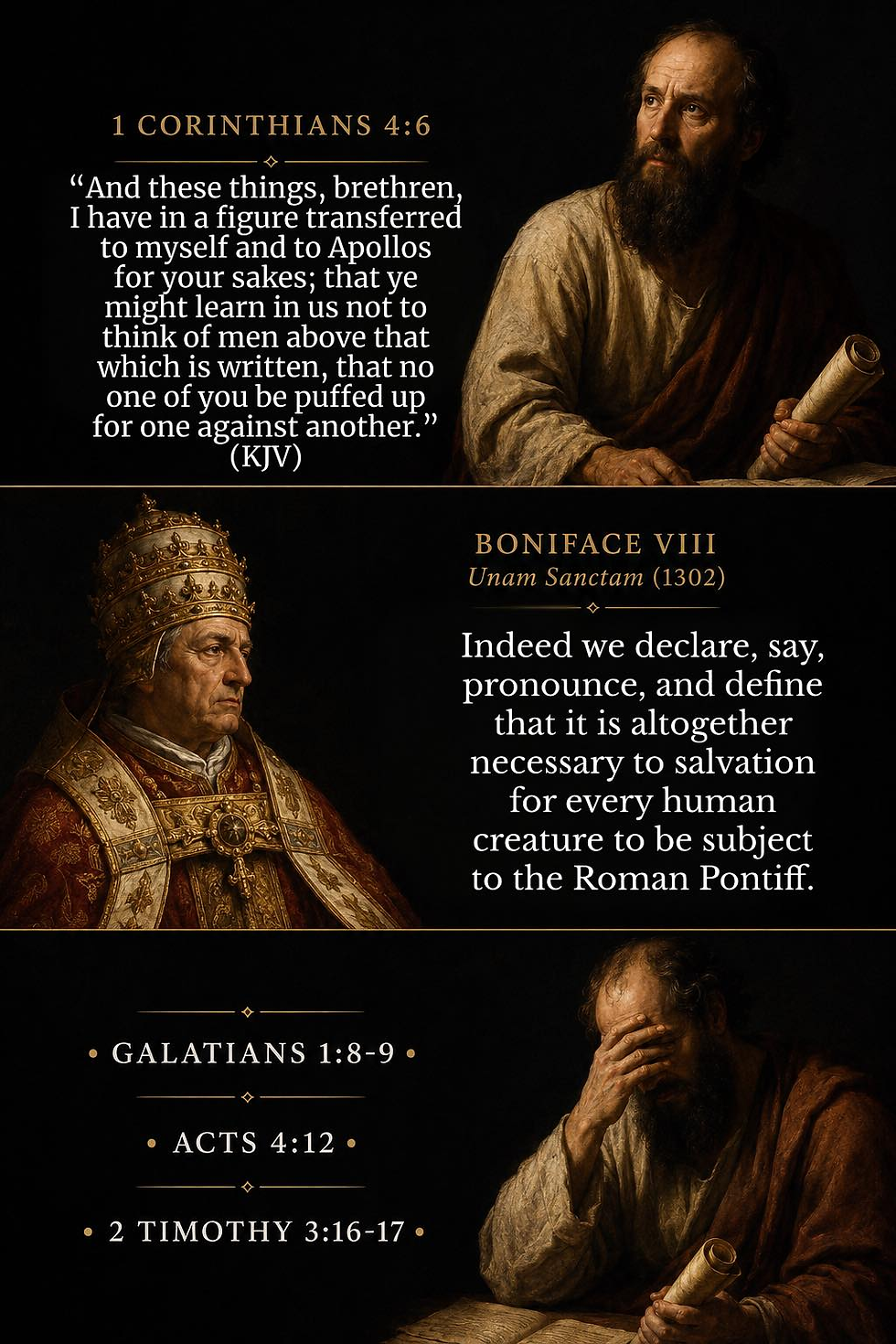
Let us therefore rejoice that even in pretense, Christ is preached even in the Catholic Church. Thus, there is a golden opportunity for those within its snare to be truly born again. By coming to Him. Not to the Pope, who declares "...we declare, we proclaim, we define that it is absolutely necessary for salvation that every human creature be subject to the Roman Pontiff." (2) Not to Mary, for whom even Pope Leo XIV now discourages the use of the title "co-mediatrix" (3). No, "...there is no other name under heaven given among men by which we must be saved.”" (Acts 4:12). "For there is one God and one Mediator between God and men, the Man Christ Jesus, who gave Himself a ransom for all, to be testified in due time," (1 Timothy 2:5-6). Therefore, let all God's children flee the apostate Church of Rome.
References
Tertullian of Carthage - On the Resurrection of the Flesh, Chapter 37
Unam Sanctam One God, One Faith, One Spiritual Authority Pope Boniface VIII - 1302 Bull of Pope Boniface VIII promulgated November 18, 1302 (link)
DICASTERY FOR THE DOCTRINE OF THE FAITH Mater Populi Fidelis Doctrinal Note on Some Marian Titles Regarding Mary’s Cooperation in the Work of Salvation (link)
AI usage
The header image was generated with ChatGPT.


Comments