


You don't have to believe in Sola Scriptura

Updated: Sep 15

Contrary to the protestations of pseudo-christian offshoots, Sola Scriptura is a Biblical doctrine. We have learned from none others the plan of our salvation, than from those through whom the Gospel has come down to us, which they did at one time proclaim in public, and, at a later period, by the will of God, handed down to us in the Scriptures, to be the ground and pillar of our faith. Among the things that are plainly laid down in Scripture are to be found all matters that concern faith and the manner of life.
All of this means an argument from Biblical silence is an entirely legitimate argument against a doctrine that is not found in Scripture. At best, that which has no authority from Scripture, we may as easily despise as approve. It is impossible to establish a binding doctrine without Scriptural precedent.
But suppose you don't believe in Sola Scriptura. Suppose you believe there are things God wants us to believe, but He forgot to have one of His prophets or Apostles write down. When encountering an argument from silence, it makes sense to reject Sola Scriptura. You do still have an issue here. Two of them, in fact.
The first is that you appear to be accepting your opponent's premise. A denial of Sola Scriptura does not refute the fact that Scripture does not support your argument, but rather, seems to confess it. A far more powerful response would be to show that the Bible does, in fact, support your claim. This is known as a "steel man argument". It shows that the strongest form of your opponent's argument does not work. Furthermore, even if your opponent retains his belief in Sola Scriptura, he will be forced to admit your tradition. This is why Christians still believe in the doctrine of the Trinity despite the word being man made. In theory, we could reject the terminology, but the terminology simplifies and accurately describes the Biblical data. The Bible does teach the Trinity, and so if someone asks you "where does the Bible teach the Trinity?", it makes no sense to deny Sola Scriptura.
The second problem you have is that even if we grant there are other authorities aside from Scripture, the burden of proof is on the one claiming to be that authority to prove their authority. You can't just show up, say "thus saith the Lord", and have the whole Church immediately assume you are correct. As Scripture says, "Test all things; hold fast what is good." (1 Thessalonians 5:21).
It's worth noting that Paul and the other Apostles submitted to this very test. In Acts 17:10-12, we read "Then the brethren immediately sent Paul and Silas away by night to Berea. When they arrived, they went into the synagogue of the Jews. These were more fair-minded than those in Thessalonica, in that they received the word with all readiness, and searched the Scriptures daily to find out whether these things were so. Therefore many of them believed, and also not a few of the Greeks, prominent women as well as men." Notice, Paul and Silas didn't show up declaring their authority to interpret Scripture. Rather, Scripture commends the Bereans (and also a few Greeks) for searching the Scriptures daily to find out whether their teachings were true. The logical conclusion is that a preacher of truth will submit to the test of Scripture, knowing that they will pass it. We can reverse engineer this to suggest that a false teacher, knowing they won't pass it, will actually resist these tests. To discourage the test of Scripture, therefore, is to fail it immediately.
All of the above, however, applies only in scenarios in which the argument is from Biblical silence. That is, "where does Scripture say...", or "Scripture does not say". But the problem for the average Joe is they've been trained on a particular script. They don't know the issues, they just have default responses they give in reply to anything it sounds vaguely appropriate for.
This leads to attacks on Sola Scriptura where it is very much not appropriate. Specifically, when the Bible is cited, and especially when multiple passages are brought up. Here, an attack on Sola Scriptura isn't actually an attack on Sola Scriptura. Rather, it's an attack on Scripture itself.
Ultimately, regardless of whether or not you believe the Scriptures are the sole and sufficient authority, you do have to admit that they have authority. More authority than your congregational leaders. More authority than your denomination. More authority even than the so-called Church "Fathers". In fact, beyond all imagination, it holds more authority than its authors (1 Corinthians 4:1-2, Galatians 1:8-9).
See, ultimately, the Bible is breathed out by God (2 Timothy 3:16-17). It doesn't come from men's own private interpretations, but rather, the Holy Spirit guided them to write (2 Peter 1:19-21), as the wind drives a ship. This doesn't mean they went into some kind of trance, with every word being 100% from God and 0% from them. No, they wrote Scriptures according to the wisdom given to them (2 Peter 3:14-16), as men whom the Lord had made trustworthy (1 Corinthians 7:25). They were guided by the Holy Spirit into all truth (John 16:13), and they shared it with us that we may keep it, whether by their word, or their epistle (2 Thessalonians 2:15).
What this means is that if the Bible says a thing, we are required by God to heed it. It's even possible your own religion may also require it. For example, denial of Sola Scriptura, especially by name, tends to come from Roman Catholics. Yet, the Catholic Church officially teaches "Therefore both sacred tradition and Sacred Scripture are to be accepted and venerated with the same sense of loyalty and reverence." (Emphasis added) (1).
Catholics, therefore, are literally not allowed to treat Scripture as though it had any less authority than their "sacred tradition". They can disagree on what it means, but to deny what it says is an affront to Christianity and Catholicism.
The same can be said for many other religions that deny Sola Scriptura. Of course, for Liberals and similar heretics, this might not be as strong. If you legitimately reject the authority of Scripture, that's another matter. But if they even know what Sola Scriptura is, they rarely oppose it when confronted with what Scripture says. They take the logical route: Attack the passage in question.
You see, then, that regardless of whether or not you believe in Sola Scriptura, mentioning that belief in any debate not directly related to Sola Scriptura is tipping your hand! It's a red herring, because it distracts from the issue at hand. It could also be a motte and bailey fallacy depending on whether or not you're rushing to it as something you find easier to defend. What it isn't is an adequate defence against a Biblical case. In the Christian faith, what Scripture says goes. Anyone who stands against this places themselves in direct opposition to the prophets, the Apostles, and the God who inspired them.
References
Dogmatic Constitution on Divine Revelation, Dei Verbum, Chapter 2, November 1965 (link)
AI usage
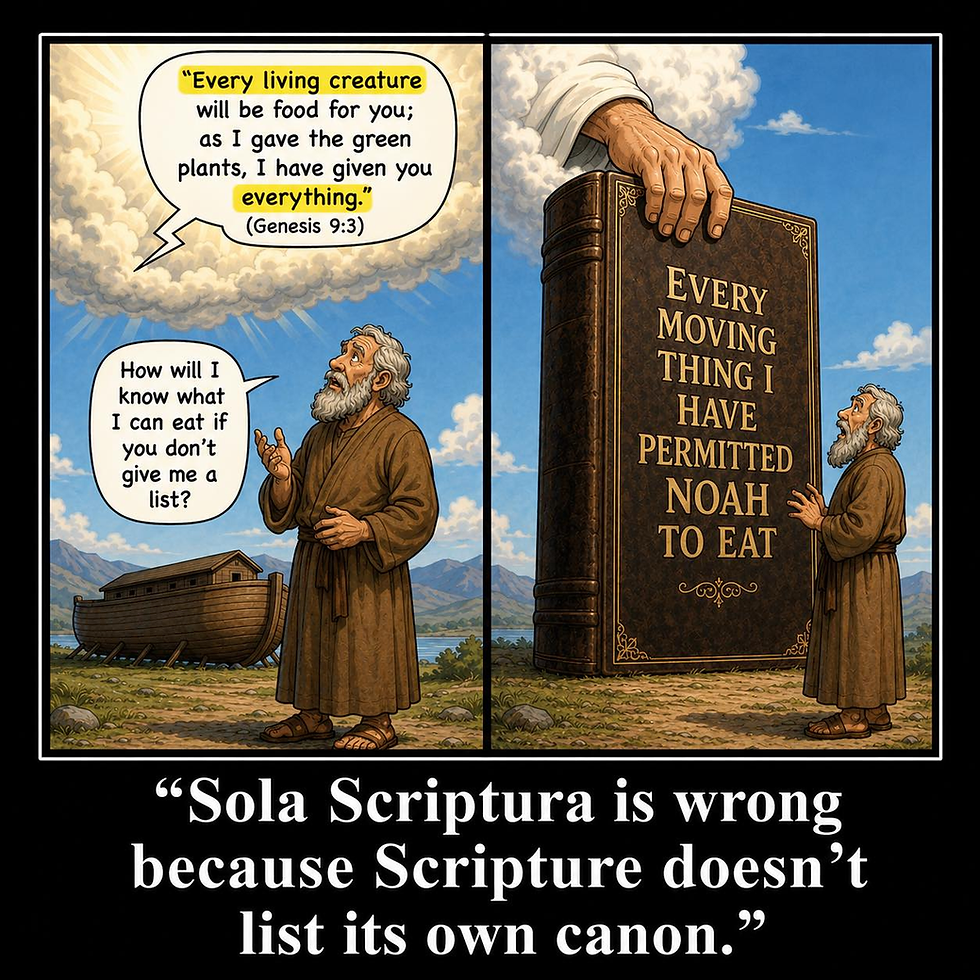
The header image was generated by ChatGPT.


Comments