


On the argument that the Bible doesn't list its own canon

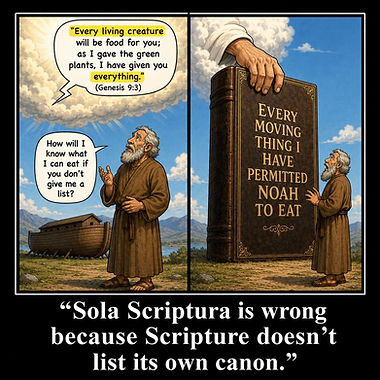
One of the biggest problems with discussing Sola Scriptura is the extreme rarity of opposers who actually understand what they are opposing. The overwhelming majority of arguments against Sola Scriptura are based, in whole or in part, on a misunderstanding of what it means. Take, for example, the argument that Scripture doesn’t list its own canon, and therefore Sola Scriptura cannot be true. This is an argument no one competent is going to make, because no one competent is going to fall for it. However, because incompetence abounds on both sides, this terrible argument continues to be one of the most popular arguments against Sola Scriptura.
It should be fairly obvious that this argument is a failure, because the fact that the Bible doesn't list its own canon has been known for over 2,000 years. If Sola Scriptura could be so easily refuted with this one simple fact, it would have been dead before it even got started. But it still persists 2,000 years later.
The problem here is that Sola Scriptura is not, has never been, and will never be the idea that Scripture is entirely self-contained. The common caricature of God just dropping a book from the sky is exactly that: A caricature. A straw man. When committed with knowledge, a lie. What we do believe is “All Scripture is breathed out by God and profitable for teaching, for reproof, for correction, and for training in righteousness, that the man of God may be complete, equipped for every good work.” (2 Timothy 3:16-17). That phrase “all Scripture” encompasses a category. A “canon”, if you will. According to its logic, Scripture necessarily includes all works that are God-breathed, and excludes any that are not.
This concept is not alien to Scripture by any means. Take, for example, Genesis 9:3. Here, God tells Noah “Every moving thing that lives shall be food for you. And as I gave you the green plants, I give you everything.” (Emphasis added). Just as 2 Timothy 3:16 encompasses a category, Genesis 9:3 encompasses a category. That category is not at all confusing. Noah didn’t need a book detailing all the foods he was allowed to eat, God’s word was sufficiently clear to him, as it is to us today. We don't need the Bible to tell us whether or not we can eat a bacon sandwich, or a cheeseburger, or pineapple on pizza (but don't do that, it's disgusting 🤪).
In similar fashion, there is a popular saying that the canon of Scripture “is not an authoritative list of books, but a list of authoritative books”. Sola Scriptura, by this logic, applies even before we know what’s on that list. This futile argument, therefore, is based entirely on a misunderstanding. When that misunderstanding is corrected, the argument dies. Ultimately, Sola Scriptura is not a statement that requires a member of a category to name all other members of its category. Rather, Sola Scriptura is a statement that applies to all things in that category. To confuse the two is to create a straw man argument.
AI usage
The header image was generated by ChatGPT.


I can't understand how this is even an argument. Adam to Noah, everyone eats anything they can. It's not until God calls the Hebrews out of Egypt that He gives Moses the commands for how the Jews were to be different from the other people on earth. Their clothing, their habits, their food choices set them apart. It's not for God thinks its wrong for mankind to eat x, y, z, but that the JEWS will not, because it will set them apart. No controversy there.