


A frustrated rant results in a Catholic finally answering my question... Badly

Updated: Sep 3
Post Publication note: The Oratio Owl Facebook page has been deactivated.

Even though this ministry originally began on Facebook, the Facebook page is not the place to find my best material. I mainly use it for promotional purposes, audience engagement, and occasional attempts at humor. This includes the meme in the header image, which is a humorous jab at a popular argument used by Roman Catholics. Namely, the argument from denominational plurality.
As you can see in the denominationalism tab of the Reaching Catholics section, I have addressed this argument in multiple ways, many times before. Thus, I didn't see the need to write a whole new article just for one meme. So, originally, it was intended only to be a silly meme on the page. But understanding that Catholics would be tempted to take it more literally than intended (as several of them did anyway), I also added a commentary. Please note, the tone is quite harsh, because I was very tired and grumpy when I wrote it. Here it is in full:
"So freaking bored of this moronic argument 🙄 Obviously, there are more than 5 Protestant denominations, and you can probably name at least 10. But if you attempt to claim there are even 400, much less 40,000, you’re just flat out lying. Know how they get that number? They count administrative fragmentation. They literally count the same denomination multiple times just because it’s in a different place. Furthermore, the differences between the denominations that do exist are often so trivial, they’re not even mutually exclusive. The Baptist Gospel, the Evangelical Gospel, the Pentecostal Gospel etc., are all the same. So it’s all one religion. “But they have different opinions on tertiary issues…” I could not give any less of a frog’s slimy rear end 🙄 If denominations were such a major problem, how would I, a man who has no denomination, be able to safely worship in an Evangelical congregation, headed by an Anglican pastor, right next to my Baptist mother, with practically no friction between us? Simple: Because they’re the same religion. Ironically, even where there is disagreement, it’s usually for the same reason Catholicism exists: Human tradition. The Lutherans baptise infants, for example, not because the Bible commands it, but because Luther was initially a Roman Catholic, and he wasn’t perfect by any means. So I like to say Protestants disagree on Scripture for the same reason Catholics disagree WITH Scripture. And like it or not, Catholics, ya do. Hardcore you do. That’s why we’re having this discussion instead of actually opening the blessed book. If the Bible was a Catholic book, Catholics would argue like Protestants. Instead, they have to resort to arguments that effectively amount to “not all denominations can be true, therefore ours is”. And frankly, if that’s the level of reasoning to which you resort, I have exactly no faith in your ability to tell me what’s in the book I’ve actually made the effort to read."
With the meme posted, and the argument sufficiently fleshed out to make it fairly defensible if need be, I attempted to sleep. But the next day, I discovered the meme had been shared by a (now deactivated) Catholic page called Oratio Owl, including a response. The response was fairly predictable, using a lot of the same rescuing devices as every other Catholic who uses the denominations argument, and even regurgitating other common lines from the Catholic scam script. But one thing that caught my attention is the fact that Oratio Owl is the first Catholic, at least to my memory, to ever attempt to address one of my most asked questions on this topic: "If denominations were such a major problem, how would I, a man who has no denomination, be able to safely worship in an Evangelical congregation, headed by an Anglican pastor, right next to my Baptist mother, with practically no friction between us?"
I've debated literally hundreds of Catholics, but I don't remember a single one of them attempting to address that point. Because Owl did, this article is warranted. So, I am writing this article to give a full, point by point response to Oratio Owl's attempt to respond to me. I will first reproduce it in full, then respond to it quote by quote. I will also provide a contents dropdown so you can navigate the article as you see fit.
Owl's Reply
"without getting sucked into the numbers game or "we're all Christians, so it doesn't matter who is correct" framing I'd like to address this as amicably as I can on a single cup of coffee.
No one actually cares whether it’s 40,000 or 40 protestant denoms. The point isn’t the actual number. It’s that Protestantism has no mechanism to stop fragmentation at all.
If "we’re all the same religion" were true, then please explain why groups disagree on big topics like infant baptism, salvation security, women’s ordination, church authority, what the Eucharist is.
None of those tertiary issues. Those are different theologies and different churches entirely.
If you can bounce between Anglican, Baptist, and Pentecostal services without friction, that doesn’t prove unity, but it proves there’s no binding authority to say who is right. And I may ruffle feathers, but it also proves a lack of conviction.
It breaks my heart to see so many Protestant friends floundering in their beliefs, trying to find the "right church for them" when they should be searching for the right church for God.
God is not the focus in that kind of search. Comfort and familiarity are.
Catholics don’t bring this up as a numbers game.
We bring it up because Christ founded one, holy, Catholic, and apostolic visible Church.
So yeah, I agree that naming 5 or 500 doesn’t solve the real problem of finding a church with the authority and consistency to faithfully guide believers."
Editor's note: While the text is copied and pasted directly, the Wix blog editor takes any text surrounded by stars as a command to italicise the surrounded text. I do not know how to prevent this.
As I suspected the post would be deleted, I also captured a screenshot of it for future evidence. The page has been deactivated, and so this screenshot is all the surviving evidence of the exchange.

Rebuttal
A confusing opening
"without getting sucked into the numbers game or "we're all Christians, so it doesn't matter who is correct" framing..."
This part is actually difficult to interpret. Does Owl interpret me as an Ecumenicist, saying my post is framed as "we're all Christians", including Catholics? Or is she referring to the way in which I genuinely suggested "Protestants" are all Christians?
Given that she actually did "get sucked into" the latter, the former interpretation is plausible, at which point Owl needs immediate correction: I do not consider all denominations to be legitimately Christian. This should be self-evident from the Pseudo-Christianity section, which of course includes Roman Catholicism, along with a few other nominally Christian denominations that most assuredly are not Christian. Furthermore, I have written two articles (the latter because I forgot I had written the former) addressing whether or not Catholics can be considered Christians. On top of this, a third article more directly addresses whether Catholicism itself is Christian. These all tend towards the same conclusion: That one cannot be consistently both Catholic and Christian, and the two religions teach mutually exclusive things on primary issues.
So, if Owl is suggesting I believe we are all Christians, referring to any denomination that merely claims it, she is already off to a bad start. However, if she understands that I'm suggesting all Protestant denominations are Christian, she's almost on the money. Of course, the original post was written in a sleep deprived state of frustration. I freely admit, while I stand by its content, it is very poorly worded. Thus, it fails to adequately convey what I have always professed here on Bible Brain: That there are true Christians in every denomination, but there are no true Christian denominations. With that said, if this is Owl's understanding, she's foreshadowing his lack of consistency, as she specifically said she would not be sucked in to the "we're all Christians" framing. Yet, she very much did attack the idea that all "Protestant" denominations are legitimately Christian.
As a final note, at no point did I say, or imply, that "it doesn't matter". Neither is this what I believe or profess. But there will be more on this particular point when we reach the slanderous claim that I have no conviction.
A hint of agreement
"I'd like to address this as amicably as I can on a single cup of coffee."
There are two things upon which Owl and I can agree. First, thank God for coffee. Second, the ideal is to discuss these issues amicably. I am of course going to contend that Owl failed to do this, given that, as we're going to see, Owl made some very strong accusations, and even directly twisted my words to sustain them. However, nobody gains anything if we're just shouting and cussing each other out. These are carnal weapons, but as Scripture says, "For though we walk in the flesh, we do not war according to the flesh. For the weapons of our warfare are not carnal but mighty in God for pulling down strongholds, casting down arguments and every high thing that exalts itself against the knowledge of God, bringing every thought into captivity to the obedience of Christ, and being ready to punish all disobedience when your obedience is fulfilled." (2 Corinthians 10:3-6). With that in mind, I seek to destroy Owl's arguments, but it would be a delight to know her soul is Heaven bound. Therefore, I will be blunt, but amicable.
Quibbling over specifics
"No one actually cares whether it’s 40,000 or 40 protestant denoms."
Actually yes, they do. The exaggerated numbers are precisely what gives the argument its "shock factor", making it appear to be a legitimate argument when in reality it is utterly devoid of sound reason. Thus, even though "The point isn’t the actual number", you're obviously not going to let an opponent get away with excessive exaggeration in order to bolster their point.
To give an example any Catholic should be able to resonate with, consider the argument from Catholic sex scandals. This is a popular argument used by atheists, and even many "Protestants". Yet, it is a bad argument, and any Catholic who hears it will roll their eyes. How does it survive? By exaggeration. You can refute it, or at least undermine it, by attacking the exaggeration, even though the exaggeration is not the point of the argument.
By disarming the exaggeration, you undermine the main point along with it. First, you show that the problem is not as large as it is claimed to be. While this isn't the same as a thorough demolition, it makes the argument harder to sustain. Second, you show that your opponent is prone to exaggeration, and therefore unreliable, effectively reversing the initial "wow, this is a big issue", and turning into "wow, why am I listening to this numpty?"
It is, therefore, both effective, and logical, to disarm exaggeration. It is ineffective, not to mention tactically suicidal, to allow an opponent to continue exaggerating to bolster a bad point. In the interest of seeking common ground with Owl, or at least convincing my readers, can we at least agree that exaggeration is poor form, and it is better to use more realistic estimates in order to present the most robust form of the argument in question? If an argument cannot survive without exaggeration or rhetorical flourish, I believe it deserves to die.
Minor clarification on my unique position
"It’s that Protestantism..."
One particular difficulty in apologetics is that while you can learn the basics of an argument or position, you cannot be expected to extensively know every opponent you can possibly encounter. I have never encountered Owl before, and she shows no evidence of having encountered me either. Thus, she can be forgiven for not knowing certain details that, as far as I know, are unique to me. With that said, I do not consider myself a "Protestant", nor do I typically use the term unironically or without air quotes. In the past, I have written on this topic in greater depth, but for sake of what little brevity can be achieved with this article, I will summarise my position with bullet points, and leave links to the articles afterwards.
Even in its most meaningful sense, "Protestantism" is insufficient to cover all things that are considered Protestant.
There are no other denominations, including Catholic schismatics, that one requires a name for rejecting.
In general, I find it absurd to define my beliefs by what I reject. I'm not an atheist because I reject Allah, so why am I a Protestant because I reject Pope Leo XIV?
It gives the Catholic Church way too much credibility to suggest any belief I hold exists purely to defy theirs.
The beliefs I do hold existed before there was a Catholic Church to protest...
The following articles explain those facts in greater detail, and defend them with reason. Suffice to say for now, Owl made a slight, forgivable error, and had the post been written by someone identifying as a Protestant, this particular detail would be more accurate.
Absence of self awareness
"...has no mechanism to stop fragmentation at all."
I can't prove it conclusively, but there is a traceable point in my original post where I strongly suspect Owl just stopped reading. The following quote is below this traceable point: "Instead, they have to resort to arguments that effectively amount to “not all denominations can be true, therefore ours is”."

This is a sloppy way of saying, as I typically would, that the argument from denominational plurality is devoid of self awareness. To put it as I did in a previous article, if there were truly 40,000 denominations, this would make Roman Catholicism 40,001.
See, the main problem with the argument from denominational plurality is the circular reasoning of it. It assumes that Catholicism is such a unique denomination that we must default to it. As far as I'm aware, no other denomination is this narcissistic, and certainly no other denomination so regularly makes such an audacious argument. Yet, they have the same right to. Why? Because no matter which denominations are true, all the others still exist.

So basically, it's not that Catholicism has a mechanism to stop the fragmentation, it's that it has a mechanism to denounce the fragments. But that mechanism is deeply ironic. It's effectively "ok, you won't obey us, we'll call you heretics". Which, admittedly, has a little less kick now they can't burn us at the stake... But in Christianity, the correct response to men disobeying God's word is not requiring they submit to man's word. It's literally to kick the dust from your feet as testimony against the disobedient.
And this method is available to all denominations. The only difference is some denominations claim authority to bind that on the whole Church. Strong evidence of a faithful denomination is that it doesn't do that. When Christians divide from a false denomination, it's because we've searched the Scriptures daily to see if they're teaching the truth, and found them lacking. This is the same process we see occurring in Acts 17:11-13, and it's precisely the same test the Catholic Church fails by claiming authority to resist it.
Sloppy or dishonest?
"If "we’re all the same religion" were true, then please explain why groups disagree on big topics like infant baptism, salvation security, women’s ordination, church authority, what the Eucharist is."
Remember when I suggested there's a traceable point where Owl stopped reading? Well, that would be right here. There is nothing below this line that she addresses, acknowledges,

or shows any evidence of having actually read. In this case, she not only asks a question that is directly answered in the very next sentence after the one he quoted, but her first chosen example of a doctrinal difference is the exact example I chose. This means there are only two possibilities. Either Owl was too lazy to read the post, at which point she should also have been too lazy to respond, or she knew she was asking a question I had already answered, while framing her response as if it was sufficiently unanswerable to prove her point. This contradicts her initial claim to desire an amicable response, as I can think of few things less amicable than to actively misrepresent one's opponent. Whether she's sloppy or dishonest (hopefully the former), this is just poor form.
So, why DO divisions exist?
So let's read the part Owl missed one more time: "Ironically, even where there is disagreement, it’s usually for the same reason Catholicism exists: Human tradition. The Lutherans baptise infants, for example, not because the Bible commands it, but because Luther was initially a Roman Catholic, and he wasn’t perfect by any means. So I like to say Protestants disagree on Scripture for the same reason Catholics disagree WITH Scripture."
Now again, this is a sloppy explanation attached to a meme in anticipation that a Catholic contrarian would take it literally and begin naming denominations. Which, ironically, they did, both in the comments section on my post, and on Owl's. But ultimately, this is a short, relatively sloppy explanation of how denominational disputes tend to arise. This can ultimately be summed up in two words: "User error".
According to its own testimony: "All Scripture is breathed out by God and profitable for teaching, for reproof, for correction, and for training in righteousness, that the man of God may be complete, equipped for every good work." (2 Timothy 3:16-17). The inspiration element of this is also officially acknowledged by the Roman Catholic Church. The necessary conclusion of these two verses, however, is that if a person comes to a wrong interpretation of Scripture, the issue is not Scripture, but the person.
Pedobaptism is by far the best example, which is why I defaulted to it, and likely why Owl did too. But if you want to know why a Pedobaptist believes in Pedobaptism, ask them, and they'll tell you exactly why. How do I know? Because I have. In fact, I have done so often enough that I can anticipate roughly what their response will be. There are a handful of Scriptures they will likely go to, none of which are sufficient to actually establish Pedobaptism. In fact, Scripture very clearly demonstrates Credobaptism.
This forces Pedobaptists to quickly flee from Scripture and begin discussing... tradition. So, why do denominations disagree on Pedobaptism? Because their tradition tells them to. It's not because Scripture leaves this open to interpretation, but because Pedobaptists use a bad method of interpretation called "eisegesis" (the practice of reading a conclusion into the text, rather than drawing it out).
Now, I don't want to get deeper into this issue in this article, as that would not only require me to distract from the main focus, but would also raise questions about why I didn't elaborate on the other issues Owl raised. For a deeper look into this particular issue, the Baptism section has a tab for Credobaptism vs. Pedobaptism. Most of her other examples have also been addressed elsewhere on the site before. Here are some links for further reading:
Eternal Security can be found in the Soteriology section. In particular, here is a key article demonstrating it.
The ethics and morality section contains a tab on family values and gender roles. I haven't written much on women's ordination specifically (yet), but ironically, I'd assume Owl and I have similar views here, and if she's worth her salt, she'd be able to hold her own in a Biblical debate on it.
My key article "The Need of Authority" firmly addresses the issue of Church authority from a Catholic perspective. The Reaching Catholics and Sola Scriptura sections also thoroughly address this issue, both with and without Catholicism in mind.
Not surprisingly, the Eucharist is also addressed (from a Catholic perspective) in the Reaching Catholics section, as well as in a less Catholic-focused way in the Communion section. My key article "A brief case against transubstantiation" also explores, in a historical, scientific, and Biblical way, why the Catholic view of the Eucharist is unsustainable.
With all of that out of the way, I can say that the same principles apply to all of them. Scripture presents the correct view, and with diligent study, we can find it. When we get it wrong, the problem is user error, often due to human authority attempting to overrule God.
What are tertiary issues?
"None of those tertiary issues."
There is an understandable miscommunication here, likely resulting from a combination of Owl's insufficient caffeination, and my insufficient sleep and high levels of irritation. I did not make it clear, and thus Owl likely did not understand, that the part where I say "“But they have different opinions on tertiary issues…”" is a hypothetical Catholic response (though based on real Catholic responses I do regularly receive). In fact, ironically, it is an exaggeration. So, after criticising me for calling out exaggerations, Owl has called me out on the basis of an exaggeration.

Having established the context, you see that I was not suggesting all denominational divisions are over tertiary issues. In fact, one reason this was such a poor choice of words on my part is that it's not entirely clear what a "tertiary issue" even is. It's like saying "is 10 a lot?" Without clarification, you can't say yes or no. In the same way, these divisions of "primary", "secondary", "tertiary" etc. are fairly ambiguous. So, rather than make the point she hopes she's making, for Owl to confidently assert that these are not tertiary issues is practically guaranteed to stall the discussion.
Now, Scripture itself does not use these terms to define the importance of a doctrine, but it does show that there are issues over which we cannot afford to differ, and issues we can. And the latter are not all equal. A primary issue would be something we cannot differ on. A secondary issue would be something we shouldn't differ on, but won't go to Hell if we do. A tertiary issue would be something that might cause friction, but isn't sufficient to say you're even rebellious, much less outside the faith.
To add to the confusion, these categories can actually blend. A tertiary issue can become a primary issue. Take Ellen G. White's view that worshiping on Sunday is the mark of the beast, for example. On its own, the Sabbath is probably lower than even a tertiary issue, because the Bible very explicitly forbids bickering over the Sabbath (see the Christian Liberty section). But because she made it a Gospel issue, and Paul says those preaching a different gospel are anathema (Galatians 1:8-9), she has made it a primary issue. In a similar way, while the nature of the Eucharist, for example, would not be a primary issue, the Catholic Church has made it so.
Most of the above is just my understanding, and as I say, there is no universally accepted system. But I think we can agree that it's just not worth dividing the Church over such trivial issues as, for example, musical preferences. If one church uses a wide variety of instruments in a worship service, but another sees this as inappropriate and irreverent, that might cause petty bickering, but Jesus isn't going to look at the two believers on Judgement Day and say "right, only one of you can come in". Yet, this is an issue that has literally divided denominations in the past.
"Those are different theologies and different churches entirely."
Once again, Owl is lacking in self awareness, because by bringing up what she is presumably suggesting are primary issues, she's actually giving me the same escape route she will inevitably take when I say one word: Sedevacantists.
Sedevacantists are a schismatic Catholic group which believes there has been no true Pope since Pius XII (1939 - 1958 A.D.). One might call Sedevacantists a "Catholic denomination". Owl, however, probably won't. Rather, she will suggest that because they are divided over a primary issue (namely the Papacy), Sedevacantists are not Catholic in any meaningful sense. But by the same token, if a supposedly "Protestant" group differs on a primary issue, I can similarly dismiss them as not Protestant in any meaningful sense. The obvious example is Mormons, which some Catholics count as Protestant, but they are neither Protestant, nor Christian.
Ultimately, there is nothing a Catholic can do to escape the argument from denominational plurality that a Christian cannot also do. In fact, ironically, there is something a Christian can do that a Catholic cannot: Appeal directly to Scripture.
Deceptively twisting my words
"If you can bounce between Anglican, Baptist, and Pentecostal services without friction..."
You may notice in my response to Owl that I am quoting her directly via copy and paste. The only editing I've done is change the color to suit Bible Brain's color code. But despite her claim to be attempting an amicable response, she does not afford me the same courtesy. Rather, she actively changes my words to commit a textbook example of the straw man fallacy. If you have to do that to make an accusation stick, that's your first clue that you're doing something very wrong. Let's have a look at what I actually said:
"If denominations were such a major problem, how would I, a man who has no denomination, be able to safely worship in an Evangelical congregation, headed by an Anglican pastor, right next to my Baptist mother, with practically no friction between us? Simple: Because they’re the same religion."
So, aside from citing the wrong denominations, Owl actually made it look like I'm talking about "bouncing between services". In reality, I mentioned the same congregation I have attended for over a decade, containing members of a minimum of 3 different denominations. One of those members is actually the pastor, so obviously he's not "bouncing" anywhere any time soon. Another is my mother, who would not be able to "bounce" anywhere because, due to disability, that would also require me to "bounce" with her. The third is myself, who has only occasionally attended other congregations, and usually for specific, primarily situational reasons not remotely related to the denomination (like when I spent a Sunday in the U.S.). Obviously, in an Evangelical congregation, you're going to find at least a few people identifying as Evangelical, too.
What I left out for simplicity's sake is that, while Catholics make out that you can walk across the street and find a Church as distinct as a mosque, my congregation also happens to be heavily populated with foreigners. South Africa, Nigeria, Ukraine, Ireland, El Salvador, these are just the places my local brethren hail from. So why aren't there golden calves popping up around the building? Because we're united by something bigger than our petty differences.
Does literal unity prove unity?
"...that doesn’t prove unity..."
Not only does it "prove" unity, it literally is unity. As Scripture says, "Now you are the body of Christ, and members individually." (1 Corinthians 12:27). Because we are all members individually, we're all going to have differences. That's just human nature, and the Catholic Church is bound to the same law. In fact, ironically, I knew a man whose family was saved from within the Catholic Church precisely because their priest taught the Biblical truth. So you basically have at least one sheep in wolf's clothing, while the wolves pretend their pack is perfectly united like a hive mind!
In the mean time, while my congregation is filled with individual members, we are all united under the true Head of the Church: Christ Himself. So it doesn't matter if we're from across the street, or across the pond, we all believe the same core doctrines, we all know and love the same God, and so our multi-national, multi-denominational congregation is one holy, Apostolic, catholic Church. My congregation is the literal death knell of the argument from denominational plurality, and we are the norm, not the exception.
Who has binding authority?
"...but it proves there’s no binding authority to say who is right."
Now, what did I just say? Ironically, I actually made a similar claim to the clichéd Catholic claim "Ours is the Church Jesus founded" (which Owl is basically about to make). But the fact that we can make that claim is not the most embarrassing part of this particular argument. It's that there is absolutely no sensible way Owl is as ignorant as she is pretending to be here. No amount of sleep deprivation, no amount of caffeine deficiency, can account for a Catholic approaching someone she perceives as a Protestant and saying, without a hint of irony, sarcasm, or jest, that we do not have a binding authority to say who is right. In fact, if Owl had just had the integrity to read my post in full, any blind spots she may have had would have instantly been filled in, because I said:
"So I like to say Protestants disagree on Scripture for the same reason Catholics disagree WITH Scripture. And like it or not, Catholics, ya do. Hardcore you do. That’s why we’re having this discussion instead of actually opening the blessed book. If the Bible was a Catholic book, Catholics would argue like Protestants. Instead, they have to resort to arguments that effectively amount to “not all denominations can be true, therefore ours is”. And frankly, if that’s the level of reasoning to which you resort, I have exactly no faith in your ability to tell me what’s in the book I’ve actually made the effort to read."
Now, does that, or does that not, sound like I am saying the Bible is the binding authority that tells us who is right? In fact, does it not "strongly imply" that Catholics specifically flee the binding authority of Scripture in the full knowledge that they are in direct rebellion to it? Remember, both of our religions recognise this book as being directly breathed out by God. Therefore, it is exactly as authoritative as He is, as surely as if He stood before us and spoke it aloud with His own mouth. Basically, you cannot reject the authority of the Bible without rejecting the authority of the God who gave it to us. And contrary to the Catholic cliché "Jesus didn't give us the Bible"... Yeah, He did:

No conviction?
"And I may ruffle feathers, but it also proves a lack of conviction."
Now, I do have to confess, Owl did ruffle my feathers here. But not for the reasons she wants you to think. Rather, while I entrust myself to the one who judges justly when I am insulted (1 Peter 2:23), that doesn't change the fact that I am, rightly, insulted by such slanderous accusations. Setting aside this disgraceful and presumptuous judgement against me, Owl must learn a simple distinction: Do not mistake tolerance for validation.
See, just because an issue is not so important as to require division within the Church does not mean it is not important enough to require correction. Credobaptism is important, which is why I defend it with such passion. Eternal security is important, which is why I voice my convictions. And so on and so forth. If, as Owl so libellously asserts, I had no conviction on these issues, I would not hold a position on them. In fact, Bible Brain would not exist, nor would its policy that authors are not permitted to express a view they cannot confidently defend (which is why you won't see me express a view on tertiary issues like the timing of the rapture).
The right Church for God
"It breaks my heart to see so many Protestant friends floundering in their beliefs, trying to find the "right church for them" when they should be searching for the right church for God."
This, of course, follows on from twisting my words to suggest I bounce between services. Now, as Owl is an unreliable narrator, I strongly doubt she is accurately representing her "many Protestant friends". Not that I can speak for people I've never met, of course, but it's unlikely she really has observed them "floundering", any more than she has observed me floundering.
Which of course is not what I was describing in the original post. We all know the real reason my post breaks Owl's heart is that I am expressing a very solid conviction that the Roman Catholic Church is not the "right Church for God", because it is in direct conflict with the word of God.
"God is not the focus in that kind of search. Comfort and familiarity are."
This is something Owl and I can agree on. I deny the charge, but accept the premise: God is not the focus if you are basing your church search on your personal feelings or opinions. Here's something Owl didn't consider: If I personally was seeking comfort and familiarity, Christianity is the last place I'd look. I recently developed a saying: "Proof of my doctrine is in the Scriptures, proof of my sincerity is in my doctrine."
See, logically, if I was merely seeking comfort and familiarity, and Scripture could be plausibly interpreted in a more comfortable and familiar way, these would be the interpretations I would roll with. And there are plenty of denominations I could join that would say that's totally fine! But I don't. Why? Because I have three important elements: Knowledge, faith, and integrity. I know what the Bible says, I believe the Bible is true, and I have a desire to follow it. Therefore, I will always go with the less comfortable interpretation if it is the more likely interpretation. Thus, the accusation fails.
Why does the argument exist?
"Catholics don’t bring this up as a numbers game."
Neither did I say they do. What I did say was "So I like to say Protestants disagree on Scripture for the same reason Catholics disagree WITH Scripture. And like it or not, Catholics, ya do. Hardcore you do. That’s why we’re having this discussion instead of actually opening the blessed book. If the Bible was a Catholic book, Catholics would argue like Protestants."
So, I stated the reason I believe this argument exists: Because Catholics know their religion does not stand up to Biblical scrutiny. But Owl reduces this to "numbers games". Now, this is below the line I suspect Owl stopped reading, so it's possible she just missed this in pure, inexcusable ignorance. But the only alternative is she is being deceptive. Either way, it actually ends up proving my point. If there were any Biblical arguments for Catholicism, Catholic apologists at every level (after all, God's word gives understanding to the simple) would be using those.
"We bring it up because Christ founded one, holy, Catholic, and apostolic visible Church."
This brings us back to the circular reasoning thing again. You cannot assume Catholic authority by arguing from Catholic authority. If you believe the Catholic Church is the one, holy, catholic, Apostolic Church, you are required to show it through sound reasoning. As it stands, not even the Nicene Creed, to which this line seems to refer, includes the term "visible". This is because, as I show in my article "Where is God's tangible Church?", Scripture is significantly more supportive of the idea that the Church is the body of Christ, of which all believers are members individually.
This is actually what the term "catholic" originally meant. It comes from the Greek "katholikos" (καθολικός), which means "universal" or "general". This was initially used by Ignatius of Antioch to effectively distinguish the sheep from the goats, i.e. the Church from the heretics. It had nothing to do with the Roman Catholic Church, which at this point did not exist. This, I can prove by going to the Bible, which, when read like a book (because it is a book), strongly opposes the Roman Catholic Church.
Conclusion
"So yeah, I agree that naming 5 or 500 doesn’t solve the real problem of finding a church with the authority and consistency to faithfully guide believers."
This is quite the conclusion to a failed argument. Owl missed the point (after ironically accusing me of missing the point), criticised my one exaggeration (after criticising me for criticising exaggerations), asked questions I'd already answered, actively changed my words to make horrible insinuations about my motivations, resorted to circular reasoning to defend circular reasoning, and shows no evidence of having diligently read even the short post to which she was responding. After all this, she has the cheek to claim to represent a Church that consistently and faithfully guides believers? If this is what a believer does under the guidance of the Catholic Church, maybe it isn't the best guide after all...
But of course, I don't want to end on what is effectively an ad hominem. Owl may be a bad representative, but it's possible to divorce this from the Church she is representing. So, I return to the original point I wanted to make in the original post: If the Bible was a Catholic book, Catholics would argue like Protestants. Furthermore, they would actually win.
Because that's how we win.

When Christians say "the Bible says...", we don't assert some imaginary authority to try to gaslight you into seeing what's not there, or not seeing what is. We open the book and show it. We can show that Scripture testifies to its own authority, perspicuity, and sufficiency. We can show that Scripture presents a Gospel of grace, through faith, not of works. We can show that Scripture portrays Christ as the only sinless human being who has ever lived, and that He is our one mediator and advocate with the Father. We can show that the Eucharist is a ritual of remembrance and proclamation, rather than a true and proper sacrifice. I can show all this, and more, just from the text alone. Ironically, I can also show that the Church "Fathers" taught similar things, though this would be supplementary at best.
But Catholics will never have that advantage. When the text seems to conflict with their teaching, they have to assert authority to reinterpret it to resolve that conflict, even if their explanation - if they dare to give one - makes no sense. Which forces Catholics to ask a very uncomfortable question. If you read the Bible and find one of those places, what is the correct response? Do you obey the word of God, even if it means disobedience to your Church, or do you surrender your thinking capacity to your Church and allow them to sear your conscience, just like a Pharisee? For true believers, the answer is easy. God has more authority than any Church. Obey Him. But my Catholic friends, you have the right to choose the wrong answer. Just be aware, a perishing Church cannot save its perishing members.
AI usage
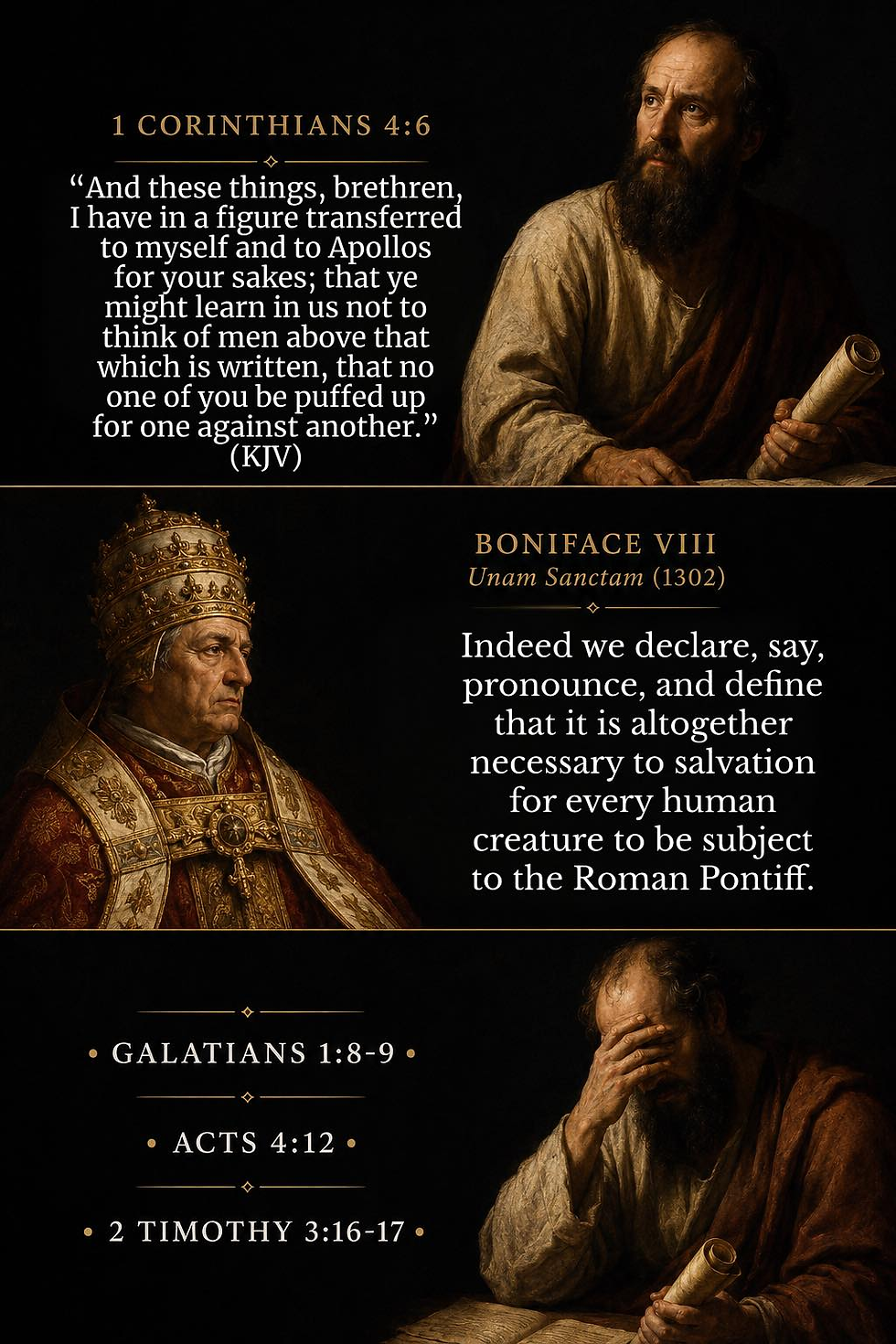
This image was generated using Chat GPT.


Comments