


Catholic Complaints about Protestant Persecution


One of the stranger methods modern apologists use is to point to things members of other religions did, without focusing on whether or not they were consistent with their religion to do it. In the header image, you see an example of a Roman Catholic attempting this method against "Protestants". Referring to the Reformation as the "deformation", he asserted that Protestants killed 50,000 non-Protestants, and that the reason Thanksgiving is celebrated in the U.S. is the escape from this.
While this particular Catholic is obviously a bad example, this is a very real argument used by modern Catholic apologists, and I have personally encountered it even from theologians. And of course, while his own knowledge borders non-existence, the Catholic in question did include a screenshot from AI, detailing genuine persecution Catholics have endured from Protestants. Thus, it's essential to address the issue.
Ironically, a partial answer can be seen in the original AI screenshot, which specifies that this pattern of state-enforced religious uniformity was "seen also in Catholic countries against Protestants". In other words, the most robust form of this argument, from a Catholic perspective, is to use it defensively. When "Protestants" point out the way in which Catholics used to persecute Christians, Catholics can effectively respond "but you did it too!"
But obviously, this wouldn't work on its own, as this would be the tu quoque fallacy. It is necessary to go deeper, highlighting the motives and powers behind the persecution. In dealing with the persecution against Christians, Catholics tend to shift the blame. Rather than accept the blame, they point out that it was actually the state that carried out the punishments in question, not the Church. William Tyndale, for example, was specifically burned at the stake under King Henry VIII.
This rebuttal falls on two swords. The first is that, while technically true, it's not as though the modern concept of separation of Church and State was the historical norm. In fact, among other reasons, abuses like this are precisely why the modern concept exists. We must also ask, if not at the behest of the Church, why would the state execute people for charges of "heresy"?
To really illustrate this problem, consider Acts 2:36 and 4:10. In both of these passages, we read "Jesus (...) whom you crucified". Yet, both passages address the Jews, who at the time did not have the authority to execute their own heretics. Certainly not using the Roman method of crucifixion. Clearly, therefore, God Himself does not accept the excuse. The delegation of a murder does not absolve an institution of guilt.
The second sword upon which this excuse falls is that if Catholics can use this escape route, Christians can use it much more effectively! A key distinction between Christianity and Catholicism is the sufficiency of Scripture. Or, as it is more commonly known with direct reference to the Catholic Church, "Sola Scriptura". This means the Christian faith was never supposed to defer to, or rule over, secular authorities. While Christians are by no means Pacifists, neither are we Jihadists. Our view is as Christ said to Pilate: "...My kingdom is not of this world. If My kingdom were of this world, My servants would fight, so that I should not be delivered to the Jews; but now My kingdom is not from here." - John 18:36
Following this same Jesus, it is our belief that when someone rejects our faith, the correct response is not to tie them to a stake and light them on fire. Rather, we kick the dust from our feet as testimony against them (Matthew 10:14; Mark 6:11; Luke 9:5; Acts 13:51). In the event that they die in their folly, the Lord will carry out due penalty for rejecting Him. Our religion is not violent, not authoritarian, and not politically dominant. Thus, we can say with 100% confidence that the persecution of Catholics, for the sole crime of being Catholic, is wrong.
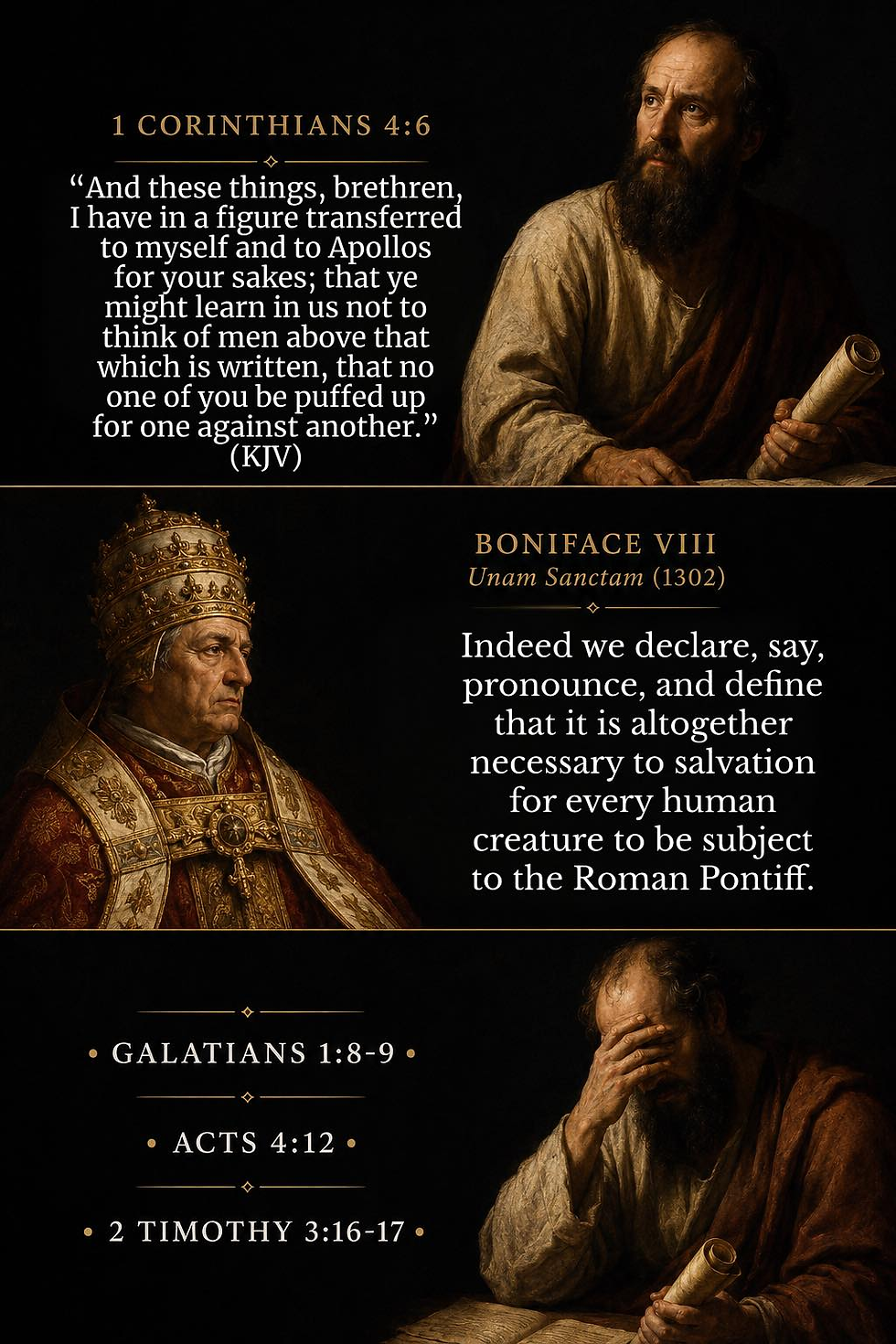
But historical Catholicism was not so inert. According to Unam Sanctam(1), there are two swords within the power of the Church: The spiritual, and the temporal. The temporal, wielded by the hand of the kings and the soldiers, is "...at the will and sufferance of the priest." Is it any wonder, therefore, that people whose sole "crime" was "heresy" were killed in such brutal fashion?
You see, then, how this particular argument has no leg to stand on. We cannot afford to dismiss history as though it didn't happen. Yes, there were times of inexcusable brutality on both sides. But we aren't supposed to interpret theology through the lens of history. Rather, we interpret history through the lens of theology. The question, then, is can either side justify the brutality? For us as Christians, the answer is a solid no. Anyone claiming the name of Jesus is reasonably bound to the teachings of Jesus. As He quite famously taught that we must love even our enemies, and pray for our persecutors, we have no right to take the role of the persecutor.
Catholics, by contrast, are faced with a dilemma. By creed, theirs is the one true Church of Christ, and thus they must also submit to His teachings. Yet, because they serve a second master - a feat Scripture tells us is functionally impossible (Matthew 6:24) - they must also deny Him. The Catholic Church officially claims jurisdiction over the secular state, which means the more aligned with the Church the State is, the more justifiable its actions become. So, if the state historically carried out the will of the Church by persecuting heretics, this is entirely justifiable.
In fact, ironically, it is harder to justify the modern tendency towards peace. But one feature of man made religions, which I of course contend Catholicism is, is cultural adaptation. Thus, as the Reformation broke Catholicism's grip on the state, Catholicism also loosened its claims. They fought, they lost, they gradually retreated to safer borders. It's not that they never asserted, nor exercised jurisdiction over the state, it's that attempting to reclaim that power is strategically suicidal.
And this gives us a golden opportunity. With the peace and relative freedom we currently enjoy, at least in the post-Christian West, we have a unique situation the Reformers could only dream of. Not only do we have the legal right to access the word of God in our own language, but we have the technology with which to do it in an instant. Physical books are an option, not a necessity. There are scores of websites and apps that provide free and instant access, many of them even having search functions. In the modern world, we can legally and practically compare the teachings of the Catholic Church to the Bible, and the only excuse for failing to do so is laziness.
But when we make use of this opportunity, it doesn't tend to go well for Catholicism. On issues ranging from minor to major, we see that the Roman Church is riddled with error! With this clarity, we not only see why Rome physically persecuted dissent, but why it continues to assert unique interpretive authority today. Without this authority, when Scripture is read like the book it is, the Catholic Church crumbles like a dry sandcastle. Thus, the better argument, rather than "you persecuted God's Church", is "you violate God's word".
References
Unam Sanctam, One God, One Faith, One Spiritual Authority, Pope Boniface VIII - 1302,
Bull of Pope Boniface VIII promulgated November 18, 1302 (link)
AI usage
The header image features a screenshot from a real comment, which itself contains a screenshot of an AI generated text.


Comments